DOWN BEAT
“Music News from Coast to Coast”
Chicago
MAY 1939
First published in July 1934, Down Beat began as a monthly journal. It became a biweekly publication in October 1939. Each issue sold for fifteen cents. The magazine was folded to 8 x 11 for newsstand display and mailing. Its thirty-two pages opened up to an impressive 11 ¼ x 15 ½ newspaper.
With the “Swing” craze in high gear, Down Beat is dominated by the big band, swing, jazz, and pop sounds of the day. A musical time capsule of spring 1939, it's jam-packed with articles, pictures, news, reviews, and instrument adverts. The two major guitar companies, promoting their acoustic guitar line, are represented by a half-page ad featuring Gibson guitar endorsers and an impressive full-page ad from Epiphone guitars showcasing Carmen Mastern with the Tommy Dorsey orchestra. At the time, Mastren, an Eddie Lang devotee, was a poll-winner and ranked as “the” top guitarist in the country. By the end of the year, the emergence of Charlie Christian and the amplified guitar would dominate the polls and begin the transition from the acoustic guitar (which Lang had brought to prominence in 1927) to the amplified instrument in pop and jazz.
LIFE OF EDDIE LANG
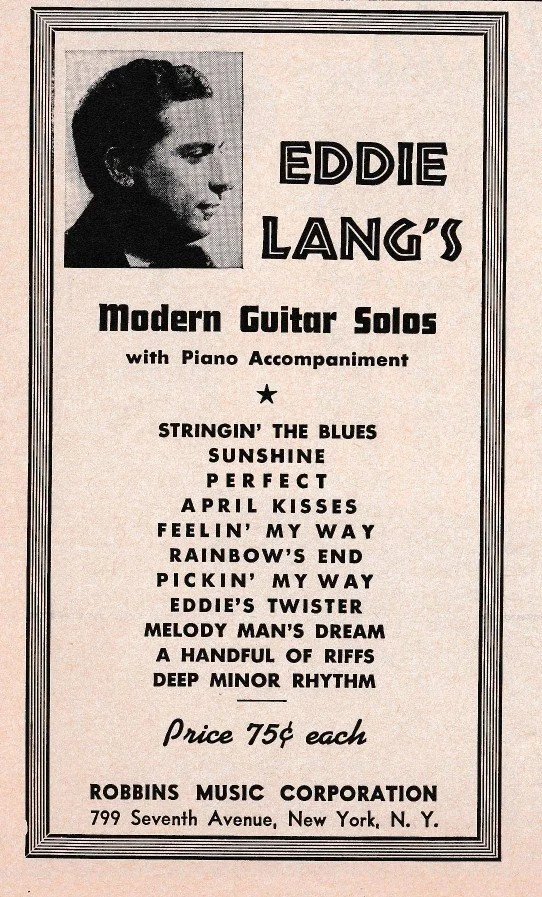
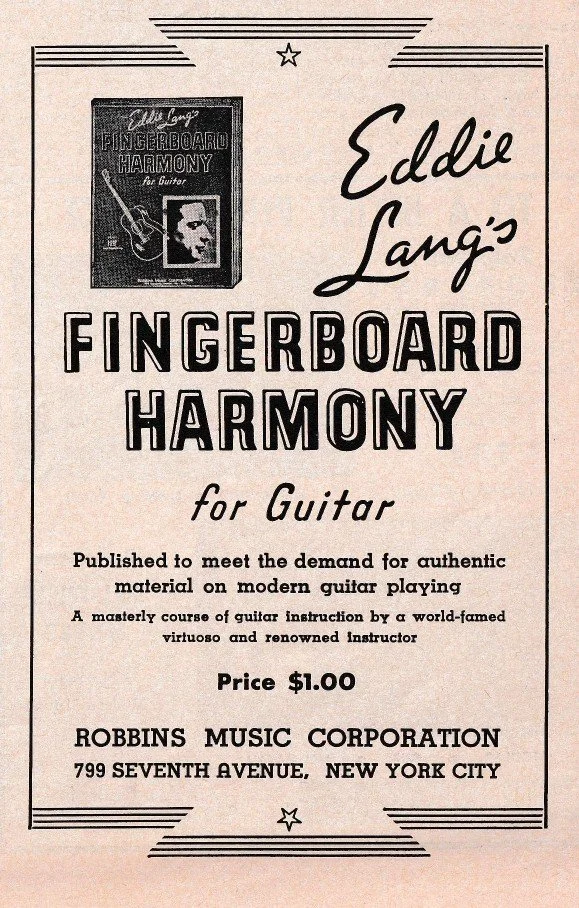
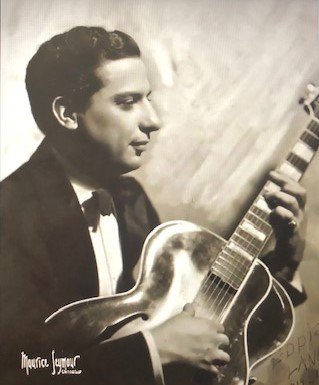
The May 1939 issue of Down Beat featured a tribute to Eddie Lang in the centerfold, in double-trunk fashion. Paul Whiteman, Frankie Trumbauer, Lonnie Johnson, and Bing Crosby each contributed reminiscences of their time with the guitarist. Ads promote Lang’s Robbins music catalog. Oddly, Joe Venuti is missing from the roster, though he gets a good share of copy, as one would expect. (see note)
NOTE: Venuti’s big band is appearing in Kansas City, Missouri, at the time of publication. Also in this issue, reviewers give the fiddler's latest Decca Records release (SOMETHING and NOTHING) a mediocre review, noting that “the titles review themselves!”
NOTE: All of the text below has been transcribed as published, with minor punctuation adjustments.
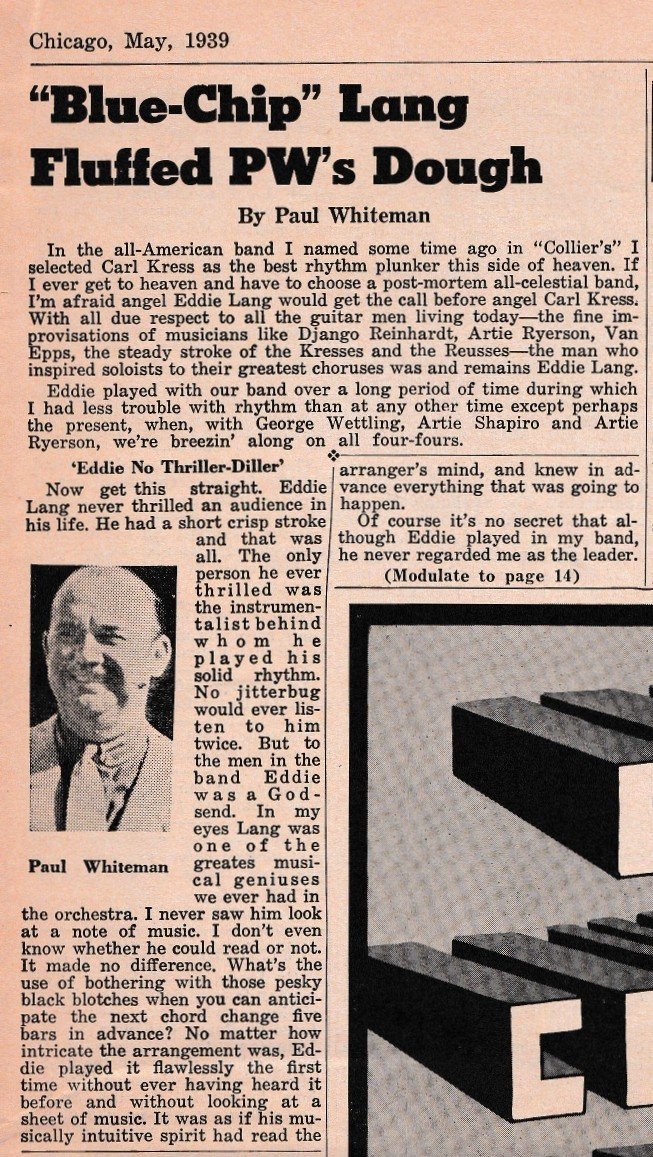
“Blue-Chip” Lang Fluffed PW’s Dough
By Paul Whiteman
In the all-American band I named some time ago in “Colliers”, I selected Carl Kress as the best rhythm plunker this side of heaven. If I ever get to heaven and have to choose a post-mortem all-celestial band, I’m afraid angel Eddie Lang would get the call before angel Carl Kress. With all due respect to all the guitar men living today, the fine improvisations of musicians like Django Reinhardt, Artie Ryerson, Van Epps, the steady strokes of the Kresses and the Reusses, the man who inspired soloists to their greatest choruses was and remains Eddie Lang.
Eddie played with our band over a long period of time during which I had less trouble with the rhythm than at any other time except perhaps the present, when, with George Wettling, Artie Shapiro, and Artie Ryerson, were breezin’ along on all four-fours.
“Eddie No Thriller-Diller”
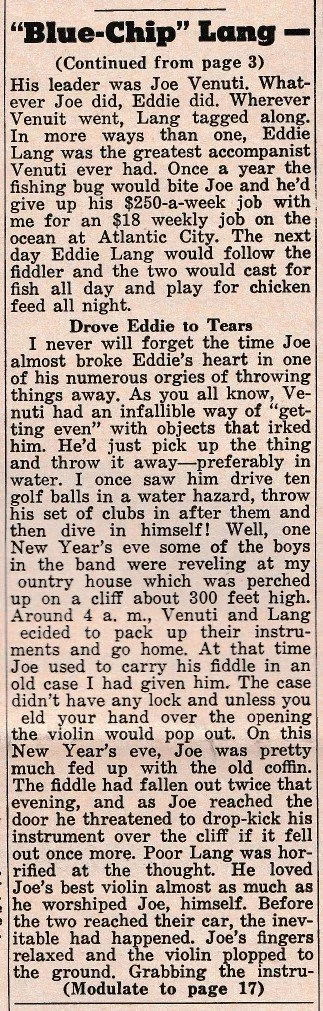
Now, get this straight, Eddie Lang never thrilled an audience in his life. He had a short, crisp stroke, and that was all. The only person he ever thrilled were the instrumentalists behind whom he played his solid rhythm. No jitterbug would ever listen to him twice. But to the men in the band, Eddie was a God-send. In my eyes, Land was one of the greatest musical geniuses we ever had in the orchestra. I never saw him look at a note of music. I don’t even know if he could read or not. It made no difference. What’s the use of bothering with those pesky black blotches when you can anticipate the next chord change five bars in advance. No matter how intricate the arrangement was, Eddie played it flawlessly the first time without having ever heard it before, and without looking at a sheet of music. It was as if his musically intuitive spirit had read the arranger’s mind and knew in advance everything that was going to happen. Of course, it’s no secret that although Eddie played in my band, he never regarded me as the leader. His leader was Joe Venuti. Whatever Joe did, Eddie did. Wherever Joe went, Eddie tagged along. In more ways than one, Eddie Lang was the greatest accompanist Venuti ever had. Once a year, the fishing bug would bite Joe, and he’d give up his $250 a-week-job for an $18 weekly job on the ocean at Atlantic City. The next day, Eddie Lang would follow the fiddler and the two would cast for fish all day and play for chicken feed all night.
Drove Eddie To Tears
I never will forget the time Joe almost broke Eddie’s heart in one of his numerous orgies of throwing things away. As you all know, Venuti had an infallible way of “getting even” with objects that irked him. He’d just pick up the thing and throw it away, preferably in water. I once saw him drive ten golf balls into a water hazard, throw his set of clubs in after them, and dive in himself!
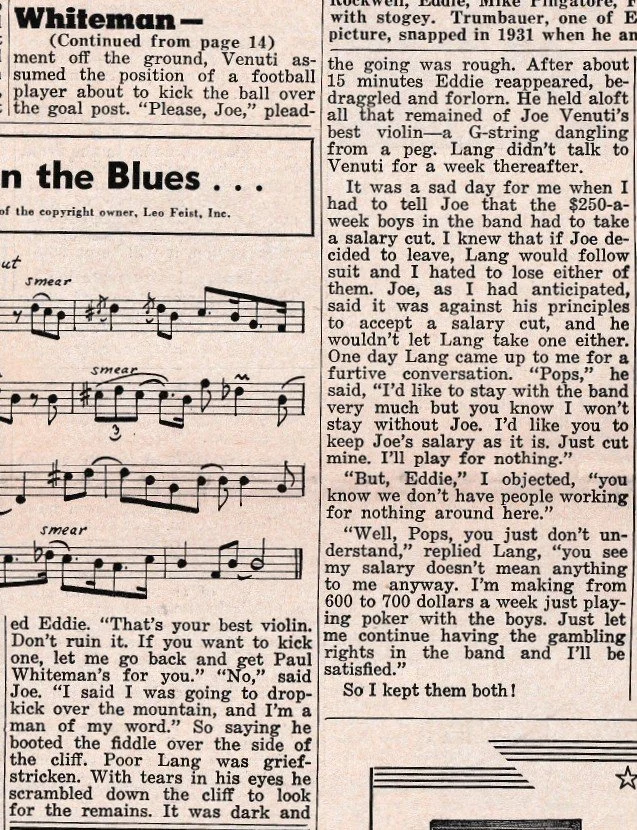
Well, one New Year's Eve, some of the boys in the band were reveling at my country house, which was perched on a cliff about 300 feet high. At 4 a.m. Venuti and Lang decided to pack up their instruments and go home. At that time, Joe used to carry his fiddle in an old case I had given him. The case didn’t have a lock, and unless you held your hand over the opening, the violin would pop out. On this New Year's Eve, Joe was pretty much fed up with the old coffin. The fiddle had fallen out twice that evening. He threatened to drop-kick his instrument over the cliff if it fell out once more. Poor Lang was horrified at the thought. He loved Joe’s best violin as much as he worshipped Joe, himself. Before the two reached their car, the inevitable happened. Joe’s fingers relaxed, and the violin plopped to the ground. Grabbing the instrument off the ground, Joe assumed the position of a football player about to kick the ball over the goal post. “Please, Joe,” pleaded Eddie. “That’s your best violin, don’t ruin it, if you want to kick one, let me go back and get Paul Whiteman’s for you.” “No”, said Joe, “I said I was going to drop-kick over the mountain, and I’m a man of my word.” So saying, he booted the fiddle over the side of the cliff. Poor Lang was grief-stricken. With tears in his eyes, he scrabbled down the cliff to look for the remains. It was dark, and the going was rough. After about fifteen minutes, Eddie reappeared, bedraggled and forlorn. He held aloft all that remained of what was Joe Venuti’s best violin, a G-string hanging from a peg. Lang didn’t talk to Venuti for a week thereafter. (1)
It was a sad day for me when I had to tell Joe that the $250-a-week boys in the band had to take a salary cut. I knew that if Joe decided to leave, Lang would follow suit, and I hated to lose either of them. Joe, as I had anticipated, said it was against his principles to accept a salary cut, and he wouldn’t let Lang take one either. One day, Lang came up to me for a furtive conversation. “I’d like to stay with the band very much, but you won’t stay without Joe. I’d like you to keep Joe’s salary as it is. Just cut mine. I’ll play for nothing.” “But Eddie”, I objected, “you know we don’t have people working for nothing around here.” “Well, Pops, you just don’t understand,” replied Lang, “You see, my salary doesn’t mean a thing to me anyway; I’m making from 600 to 700 a week just playing poker with the boys. Just let me continue having the gambling rights in the band, and I’ll be satisfied.” So I kept them both! (2)
NOTE:
1. Whiteman hosts a party for his band at his rented house in the Hollywood Hills. Tuesday, December 31, 1929, Hollywood Hills, California.
SOURCE: Paul Whiteman, Volume 1, 1890-1930, Don Rayno.
2. The timing of this is questionable, as the issue of salary cuts didn’t come to light until May 1930, due to poor box office receipts during the band's Roxy Theatre engagement (NYC), which featured the premiere of the King of Jazz film, along with George Gershwin performing Rhapsody In Blue with the Roxy Symphony Orchestra.
· Thursday, May 8, 1930, NYC. Whiteman is forced to let 10 band members go (including Venuti, Lang, Challis, and Hayton) and to reduce the remaining musicians’ salaries by 15 percent.
SOURCE: Paul Whiteman, Volume 1, 1890-1930, Don Rayno.
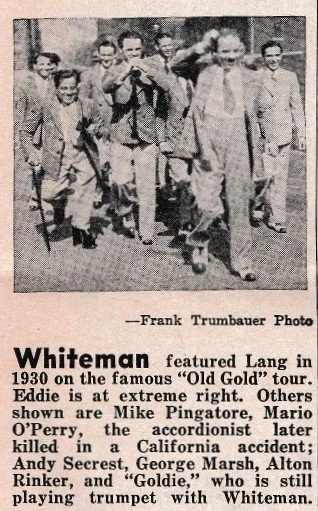
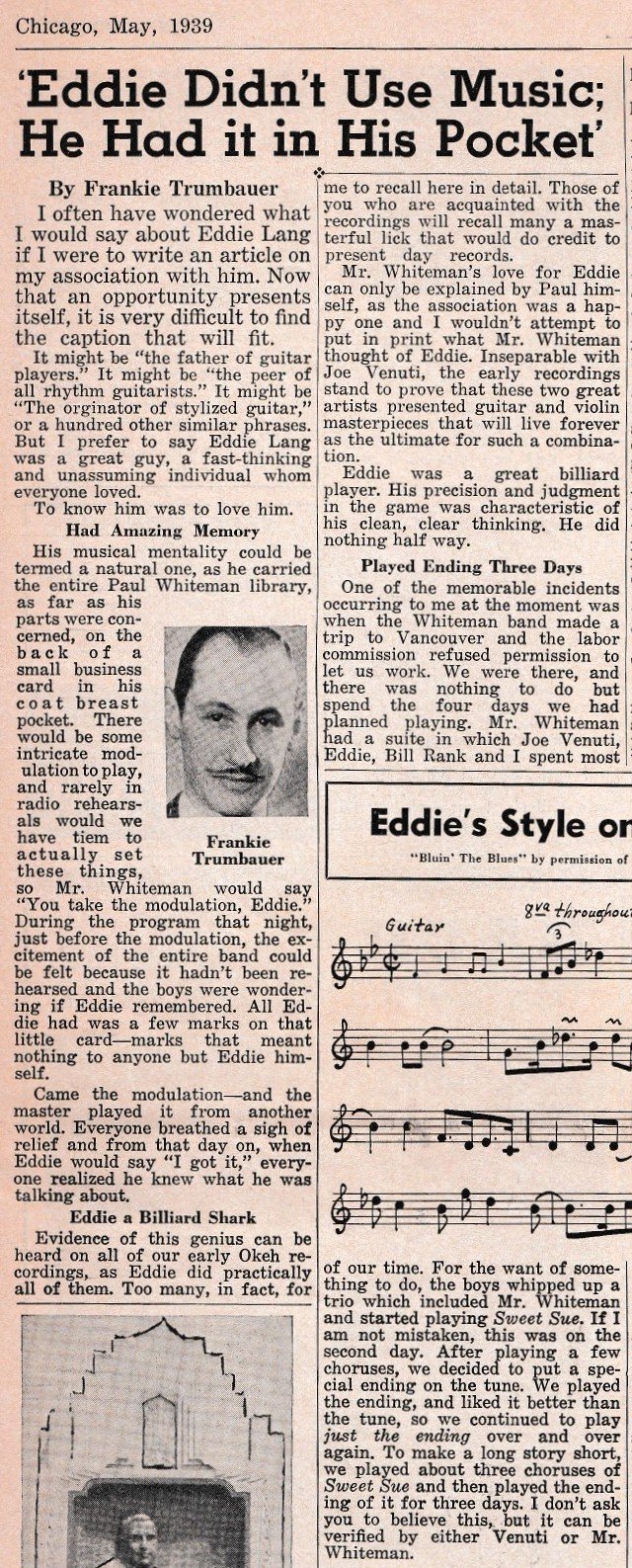
Eddie Didn’t Use Music; He Had it in His Pocket’
By Frankie Trumbauer
I often have wondered what I would say about Eddie Lang on my association with him. Now that an opportunity presents itself, it is very difficult to find the caption that will fit.
It might be “the father of guitar players.” It might be “the peer of all rhythm guitarists.” It might be “The originator of stylized guitar,” or a hundred other similar phrases. But I prefer to say Eddie Lang was a great guy, a fast-thinking and unassuming individual whom everyone loved. To know him was to love him.
Had Amazing Memory
His musical mentality could be termed a natural one, as he carried the entire Paul Whiteman library, as far as his parts were concerned, on the back of a small business card in his coat breast pocket. There would be some intricate modulation to play, and rarely in radio rehearsals would we have time to set these things, so Mr. Whiteman would say, “You take the modulation, Eddie.” During the program that night, just before the modulation, the excitement of the entire band could be felt because it hadn’t been rehearsed, and the boys were wondering if Eddie remembered.” All Eddie had was a few marks on that little card, marks that meant nothing to anyone but Eddie himself. Came the modulation, and the master played it from another world. Everyone breathed a sigh of relief, and from that day on, when Eddie would say, “I Got It,” everyone realized he knew what he was talking about.
Eddie a Billiard Shark
Evidence of this genius can be heard on all of our early OKeh recordings, as Eddie did practically all of them. Too many, in fact, for me to recall here in detail. Those of you who are acquainted with the recordings will recall many a masterful lick that would do credit to present-day records.
Mr. Whiteman’s love for Eddie can only be explained by Paul himself, as the association was a happy one, and I wouldn’t attempt to put in print what Mr. Whiteman thought of Eddie. Inseparable with Joe Venuti, the early recordings stand to prove that these two great artists presented guitar and violin masterpieces that will live forever as the ultimate for such a combination.
Eddie was a great billiards player. His precision and judgement in the game was characteristic of his clean, clear thinking. He did nothing halfway.
Played Ending Three days
One of the memorable incidents occurring to me at the moment was when the Whiteman band made a trip to Vancouver, and the labor commission refused permission to let us work. We were there, and there was nothing to do but spend the four days we had planned playing. Mr. Whiteman had a suite in which Joe Venuti, Eddie, Bill Rank, and I spent most of our time. For the want of something to do, the boys whipped up a trio which included Mr. Whiteman and started playing SWEET SUE. If I am not mistaken, this was on the second day. After playing a few choruses, we decided to put a special ending on the tune. We played the ending and liked it better than the tune, so we continued to play just the ending over and over again. To make a long story short, we played about three choruses of SWEET SUE and then played the ending of it for three days. I don’t ask you to believe this, but it can be verified by either Venuti or Mr. Whiteman.
Pingatore Gets a Name
One other incident involves Mike Pingatore and how he got the nickname of “The Devil.”
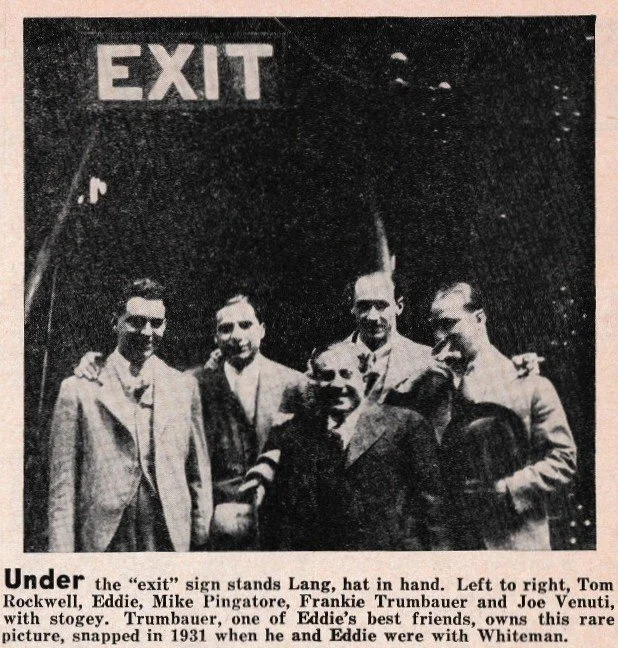
We were making the King of Jazz picture for Universal, and it was Mike’s duty to go by the house and pick up Joe and Eddie and take them to the studio. We had to be there real early every morning in order to be made up and on the set in front of the camera by 9 a.m. In the cold, gray dawn, Mike would pull up in front of the house and madly blow his horn to awaken Joe and Eddie. One morning, Venuti ran to the window, looked out, and shouted at Lang: “Get up, get up, the Devil is here.” You can rest assured that they were the first ones on the lot with the “Devil” in the driver’s seat. Because he has always been the first one to show up, Mike has been tagged the “Devil,” and it’s stuck down through the years.
Wife Was Great Pal
Mike must definitely be mentioned in this group because of the close association between Eddie and Mike Pingatore. Pingatore is, without doubt, one of the most beloved members of our great music business.
In closing this, I shall mention one of Eddie’s best pals, Kittie (sic) Lang. She was a thoroughly understanding and loyal wife whom everyone considered a part of the great master, respected and loved by everyone who knew her. There was an association between these two, Eddie and Kittie (sic), that only they understood and cherished.
To most of us who knew Eddie intimately, there are times when we can actually feel his presence. I cherish the memory and am proud to have associated with Eddie Lang, a truly great guy.
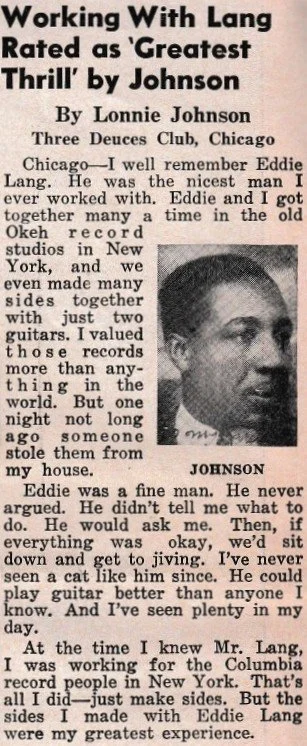
Working With Lang Rated as “Greatest Thrill” by Johnson
By Lonnie Johnson
Three Deuces Club, Chicago
Chicago-I well remember Eddie Lang. He was the nicest man I ever worked with. Eddie and I got together many a time at the old OKeh record studios in New York, and we even made many sides together with just two guitars. I valued those records more than anything in the world. But one night not long ago, someone stole them from my house.
Eddie was a fine man. He never argued. He didn’t tell me what to do. He would ask me. Then, if everything was okay, we’d sit down and get to jiving. I’ve never seen a cat like him since. He could play guitar better than anyone I know. And I’ve seen plenty in my day.
At the time I knew Mr. Lang, I was working for the Columbia record people in New York. That’s all I did, just make sides. But the sides I made with Eddie Lang were my greatest experience.
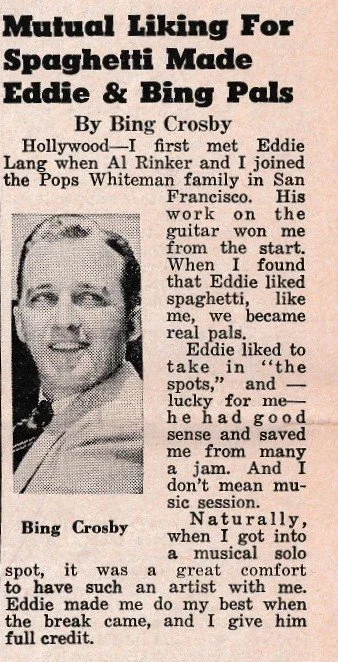
Mutual Liking for Spaghetti made Eddie & Bing Pals.
By Bing Crosby
Hollywood
I first met Eddie Lang when Al Rinker and I joined the Pops Whiteman family in San Francisco. His work on the guitar won me from the start. When I found Eddie liked spaghetti, like me, we became real pals. (1) (2)
Eddie liked to take in “the spots” and, lucky for me, he had good sense and saved me from many a jam. And I don’t mean music session. (3)
Naturally, when I got into a music solo spot, it was a great comfort to have such an artist with me. Eddie made me do my best when the break came, and I give him full credit.
NOTES:
1. Crosby & Rinker first came to Whiteman’s attention during the orchestra's 111 performance run at the Million Dollar Theatre in Los Angeles, California (September 18-mid-October 1926). Crosby & Rinker joined the Whiteman Orchestra during their Chicago engagement in December 1926. The Whiteman Orchestra returned to New York City, February 1927, and this is the assumed time that Lang (and Venuti) had the opportunity of encountering Crosby.
SOURCE: Paul Whiteman, Volume 1, 1890-1930, Don Rayno.
2. Eddie Lang (and Joe Venuti) didn’t officially join the Paul Whiteman Orchestra until May 1929. Venuti (1925-27) and possibly Lang (1926-27) had previously worked for Whiteman’s orchestra-booking agency (Paul Whiteman, Inc., or United Orchestras, Inc.), playing club dates with any of the dozen bands under the Whiteman banner.
SOURCE: Paul Whiteman, Inc. - A Preliminary Survey of the Whiteman Agency Dance Orchestras by Allan Sutton.
3. Joe Venuti recalled that Eddie Lang held on to most of his (Venuti’s) cash and eventually did the same for Crosby, both of whom were living a carefree lifestyle at the time (1927-29).
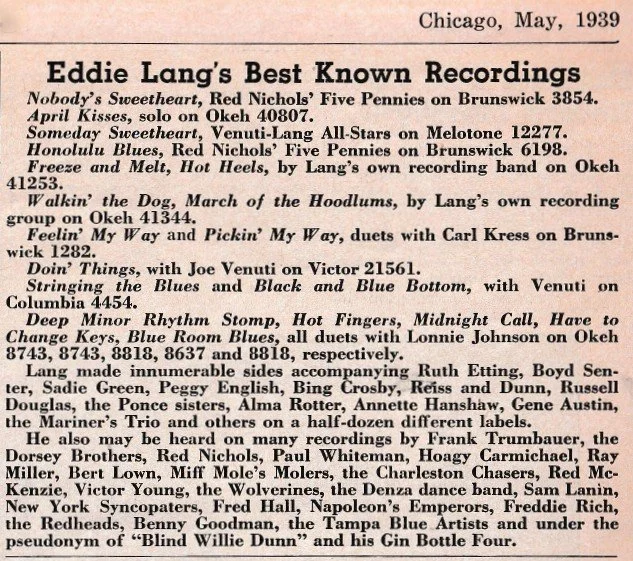
A note regarding the recordings and artists listed above.
Nobody’s Sweetheart, Red Nichols: Carl Kress is the guitarist on this recording.
There are no known Eddie Lang recordings with Sadie Green, Ray Miller, Bert Lown, the Charleston Chasers, the Wolverines, or Fred Hall.