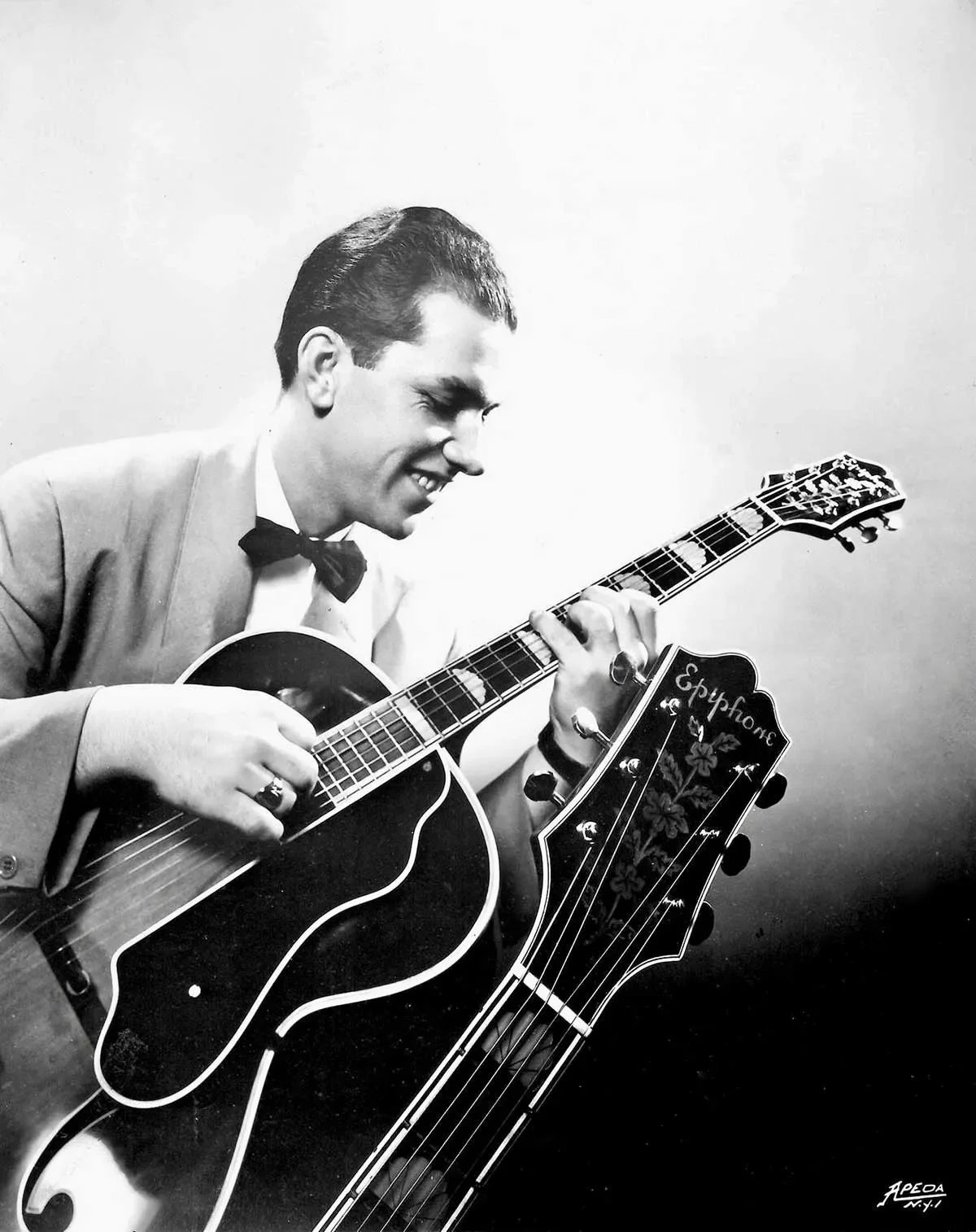
Allan John Reuss
June 15, 1915-June 4, 1988
A year-by-year timeline highlighting recordings from 1935 to 1946, showcasing Allan Reuss’s guitar solos.
Allan Reuss stands out as the premier rhythm guitarist of the swing era. Though he remains relatively unknown beyond big band circles, his steady, propulsive rhythm anchored the Benny Goodman Orchestra from 1935 to 1938, a pivotal time when jazz entered the mainstream. Reuss’s legacy is inseparable from Benny Goodman and the rise of the Swing Era, as were Willard Alexander of Music Corporation of America (MCA)*, Victor Records, and producer/talent scout/future Benny Goodman brother-in-law, John Hammond, all of whom guided & promoted the machine that propelled the Goodman band in those years. (17)
* MCA’s approach was strictly business- cold, dry, hard, but tremendously effective business. (20)
When given the spotlight, Reuss delivered vibrant solos that highlighted his mastery of advanced chord voicings—a skill honed under his mentor, George Van Eps—and distinguished him from his contemporaries.
At just twenty years old, he recorded his first session and guitar solo with Benny Goodman in 1935—a remarkable one-day session that produced fifty-one tracks!
During his three years with “The King of Swing,” the Goodman repertoire included at least three pieces that prominently featured Reuss: IF I COULD BE WITH YOU (ONE HOUR TONIGHT), ROSETTA, and LOVE ME OR LEAVE ME. Reuss was at the heart of the action as Benny Goodman and his renowned orchestra ignited and then led the Swing Era, packing an intense schedule of recordings—including sessions with Teddy Wilson, Lionel Hampton, and Billie Holiday—alongside frequent broadcasts and relentless touring. Landmark performances at the Palomar Ballroom (1935), Paramount Theatre (1937), and Carnegie Hall (1938), as well as appearances in two major films—Paramount’s The Big Broadcast of 1937 and Warner Brothers/First National’s Hollywood Hotel—further elevated his profile. Immersed in this dynamic environment, Reuss caught the attention of guitarists worldwide.
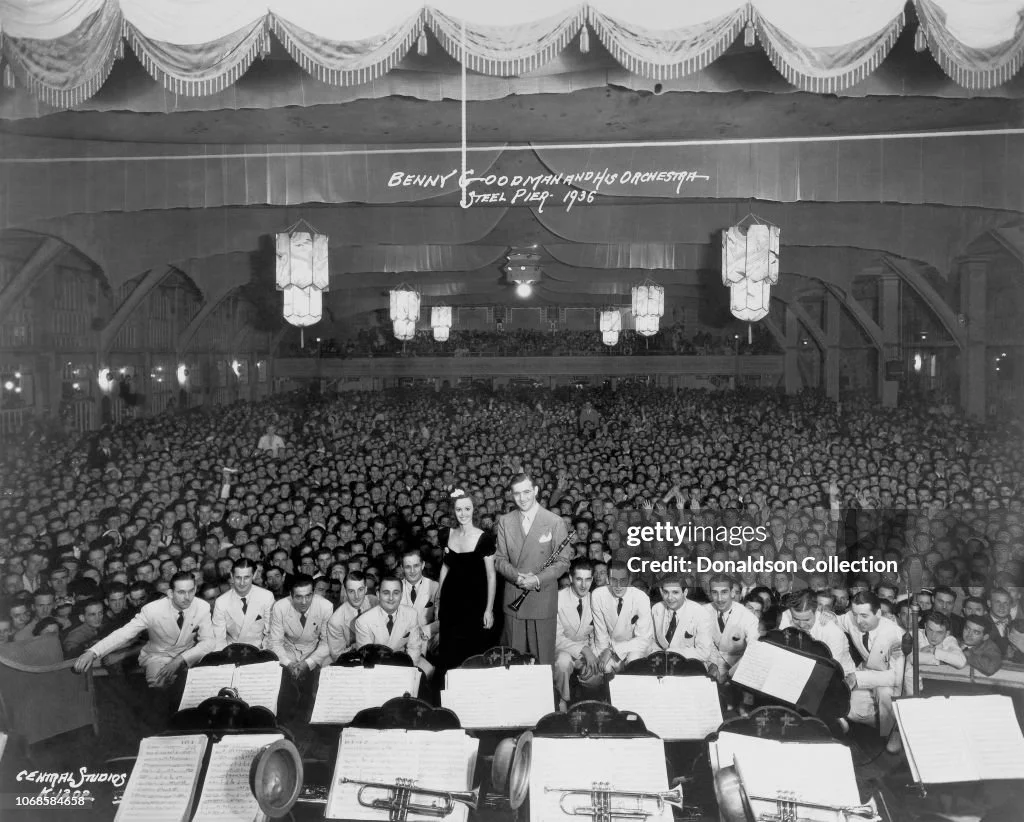
SWING IS HERE!
AUGUST 1936
Benny Goodman Orchestra, Steel Pier, Atlantic City, NJ. Surprisingly, Reuss, who was with Goodman at this Atlantic City gig, is missing from this photo capturing a sea of dancers and admirers.
The relentless demands of being part of Benny Goodman’s world eventually led Reuss to leave the band in the spring of 1938. Back in New York City, he taught and picked up gigs as they came, but had no luck finding a place in the busy recording and broadcast studios in the Big Apple. Reuss returned to the hectic pace of big band life with Paul Whiteman, then joined trombonist Jack Teagarden’s inaugural orchestra. This collaboration resulted in PICKIN’ FOR PATSY, Reuss’s first and only recording as the featured soloist.
NOTE: “Patsy” was a nickname for Jack Teagarden, not for Reuss’s wife, Cornelia.
Allan Reuss Year-By-Year Timeline Part 2 (1937–1939) follows the guitarist through his final eighteen months with Benny Goodman—at the height of the Swing Era—and into his tenure with Jack Teagarden’s first big band. Part 3 (1940–1946) finds Reuss in the guitar chair for Ted Weems, Jimmy Dorsey, Benny Goodman (again), and Harry James, eventually settling in California, leading his own trio, teaching, and resuming session work. The outstanding recordings Reuss made for Capitol (with Coleman Hawkins, 1945) and Keynote (with Benny Carter, 1946) let us appreciate his artistry in both rhythm and solo contexts, with first-rate recording quality. By isolating his solos from three takes of the 1946 Benny Carter/Arnold Ross recording of BYE, BYE BLUES, we can fully admire the remarkable swing and technique that set this distinctive, gifted instrumentalist apart—qualities few have matched or even comprehended.
PART 1: 1915-1936
1915, June 15: Born in NYC (Brooklyn/Kings County), New York.
Father: William George Reuss (b. 1886), Mother: Mary Wood “Mae” Vahlbusch (b. 1888), Sister: Virginia Reuss (b. 1911), Sister: Dolorous Reuss (b. 1918). (13)
1921: Attends public grade school in NYC (Brooklyn/Kings County) and is a member of the Art Club and the Puzzle Club. (14)
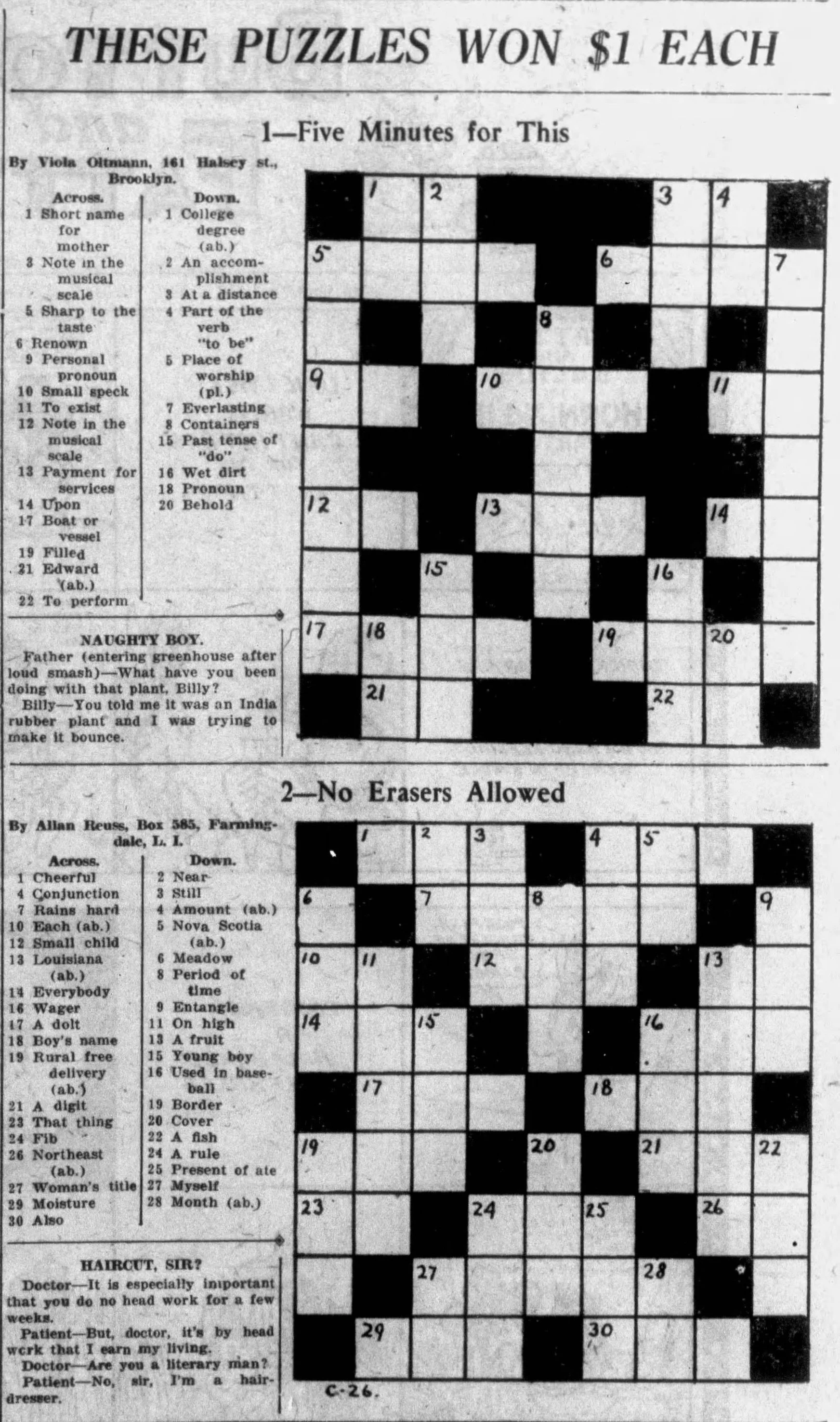
Puzzle 2-No Erasers Allowed Puzzle by Allan Reuss, The Brooklyn Daily Eagle, Sunday, November 14, 1926. The eleven-year-old is $1. richer.
1927: The Reuss family moves to Farmingdale (Long Island), New York, and he continues the last two years of grade school on Long Island.
1927, December 12: First gig on banjo, for $12. at age twelve, after only one lesson. (8)
1929: Attends Farmingdale High School; is an Honor Roll student and acts in plays and performs in the Farmingdale High School Orchestra, where he plays banjo.
1931: Is a member of St. Killian's Knights of Columbus Council.
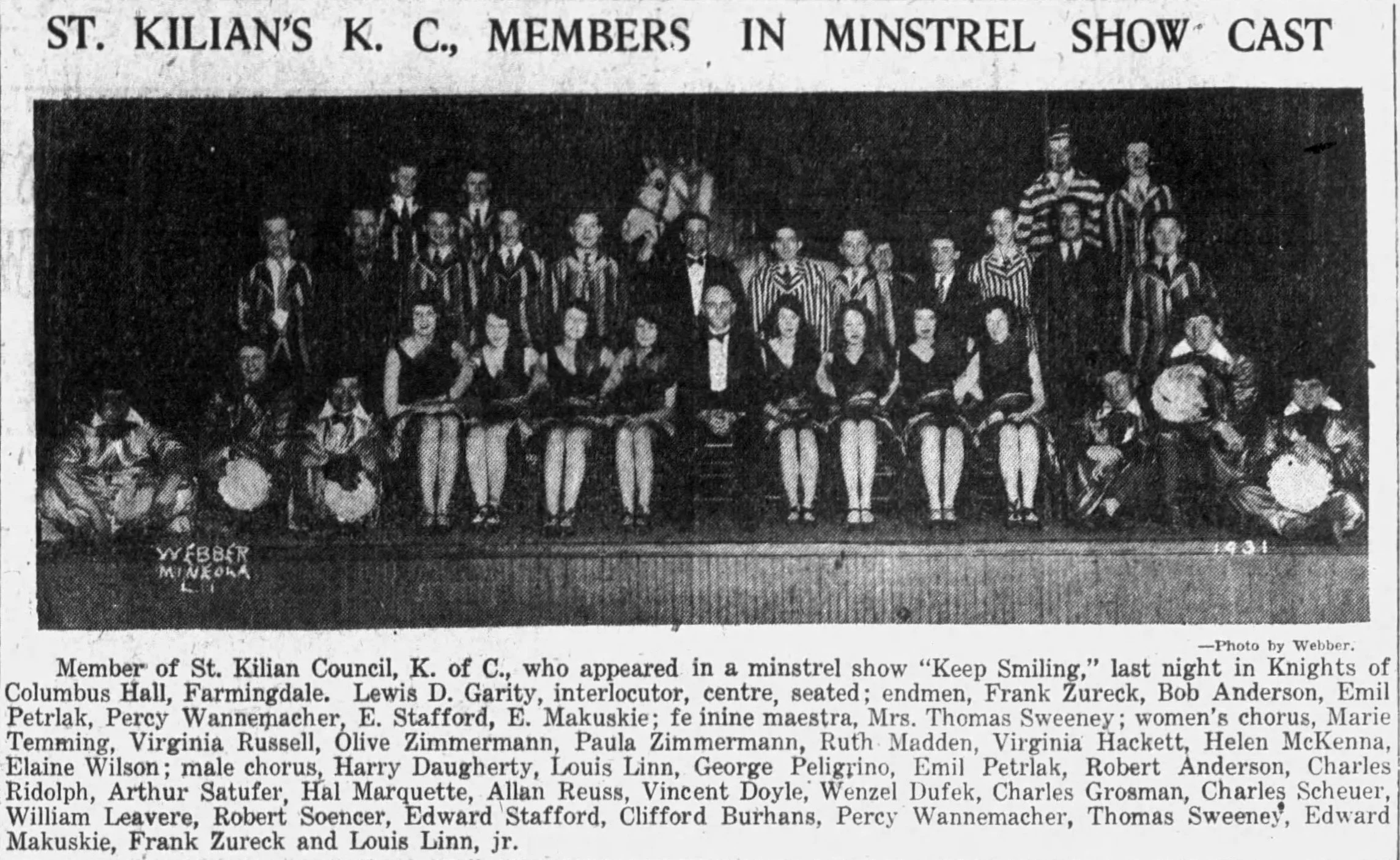
The Brooklyn Daily Times, Friday, April 17, 1931.
1933
1933: Begins studying guitar with George Van Eps, probably @ Van Eps home in Freeport, Long Island, 12 miles from Farmingdale. (9)
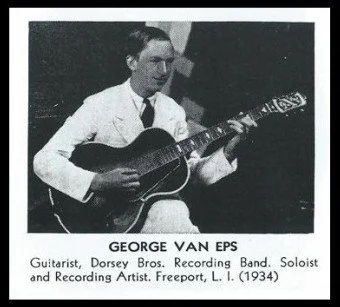
George Van Eps comes from a family of “at-once musicians and precision craftsmen (who were) fascinated with machines and how they worked, and why. A Van Eps had to be able to take a given device apart and rebuild it, improving on its design in the process. Watchmaking, passed carefully from generation to generation, was a family specialty.” (23) This heritage reveals much about George as a guitarist. Achieving his level of guitar chord solos demanded studiousness, precision, inventiveness, harmonic and technical mastery, and, above all, the ability to “swing”— traits George Van Eps possessed, and qualities that, in his own way, Reuss shared. This style’s origins reach back to turn-of-the-century banjo virtuosos such as Fred Van Eps (George’s father), Harry Reser, and Vess Ossman; to Eddie Lang’s groundbreaking chordal and solo guitar innovations of the mid-1920s and early 1930s; and to a sophisticated blend of harmonies, bass lines, and piano-inspired melodies. In George Van Eps hands and imagination, these diverse influences came together to usher the guitar into a new era of artistry. The elder Van Eps remains the master of this art form, with Reuss as his worthy disciple. In 1938, he enlisted Epiphone to construct a custom neck of his own design, introducing a seventh string—a low A—to his Epiphone Deluxe model, and in doing so, further broadened the instrument’s orchestral range. (24) Using a plectrum, he delivered a series of remarkable solos during the 1930s through the mid-1950s, before switching to fingerstyle playing. Here is an outstanding example of Van Eps' swinging solo style, captured at its finest in 1951.
1935
1935: Recording sessions with Benny Goodman, Gene Krupa.
GEORGE T. SIMON: It all began with Benny Goodman. His was the band that sparked the whole big band scene; he was the first truly important horn blower to bridge the gap between the leaders and their bands and the general public. (20)
1935, April: George Van Eps recommends nineteen-year-old Reuss as his replacement in the Benny Goodman band. (8). Reuss joins Benny Goodman Orchestra (replaces George Van Eps on NBC’s “Let’s Dance” radio broadcast). (4)
NOTE: Van Eps is in & out of the Benny Goodman Orchestra during April-mid July 1935 as he’s working with Ray Noble’s band. Wanting to remain in NYC, Van Eps leaves Goodman permanently in early July 1935 and is replaced by Reuss when the Benny Goodman Orchestra hits the road for some ten months starting ca. July 15, 1935. (4)
A demanding daily routine filled with hotel gigs, live broadcasts, and recording sessions. Owing to his association with George Van Eps, a prominent Epiphone endorser, Reuss not only played but eventually endorsed Epiphone guitars himself.
GEORGE T. SIMON: (But) early in 1935 came Goodman’s big chance, a weekly Saturday night appearance (NBC Radio Network’s “Let’s Dance”) on a coast-to-coast radio show. For the first time, all of America could now hear a truly outstanding swing band. (20)
NOTE: The Benny Goodman Orchestra made its debut on the NBC Radio Network’s “Let’s Dance” broadcast on Saturday night, December 1, 1934, at 10:30 pm ET. The coast-to-coast, three-hour program also featured the orchestras of Xavier Cugat and Kel Murray. Goodman’s final “Let’s Dance” broadcast aired on May 25, 1935. (4)
1935, April 19: First recording session with Benny Goodman Orchestra, Victor records, NYC. (4)
ARTHUR ROLLINI: On June 6th, under the name of the Rhythm Makers, we accomplished an almost incredible feat of recording fifty-one arrangements in three hours for World Transcriptions. We ran through almost our entire library, just one time, with different men filling in the vocal parts with solos. We (each) received a grand total of fifty-one dollars, one dollar per tune. (5)
1935, June 6: Rhythm Makers Orchestra (Benny Goodman Orchestra), NBC Thesaurus recording session. 51 titles recorded in one day; two feature Allan Reuss, his first recordings with a solo. (4)
1935, Tue, June 25-Sat, July 12 (TBD): Benny Goodman Orchestra, Roosevelt Grill, NYC.
GEORGE T. SIMON: This is the band about which all the musikers have been raving, raving plenty, and rightfully so. Even with one or two minor defects, the outfit is the closest to perfection this reviewer has heard in many moons. The rhythm section keeps swinging both on the pretty and the hot stuff, yet it’s never obnoxious. Plenty of credit to Gene “Hall-of-Fame” Krupa, who has that rare combination of terrific swing and technique. Ditto for Frank Froeba, who’s especially adept in the latter department. Harry Goodman (yes, a brother) and Allan Reuss (a newcomer) are easily sufficient on the rhythmic strings. (George T. Simon, June 1935, Metronome (Magazine) “A” Rated Review (excerpt). (19)
They were booked into New York’s Roosevelt Hotel (by MCA’s Willard Alexander), for years the wintering quarters of Guy Lombardo. Accustomed to the Royal Canadians, the clientele, the management, and even the waiters didn’t dig Benny. He was given notice on opening night, and the disastrous engagement came to an end three weeks later. (4)
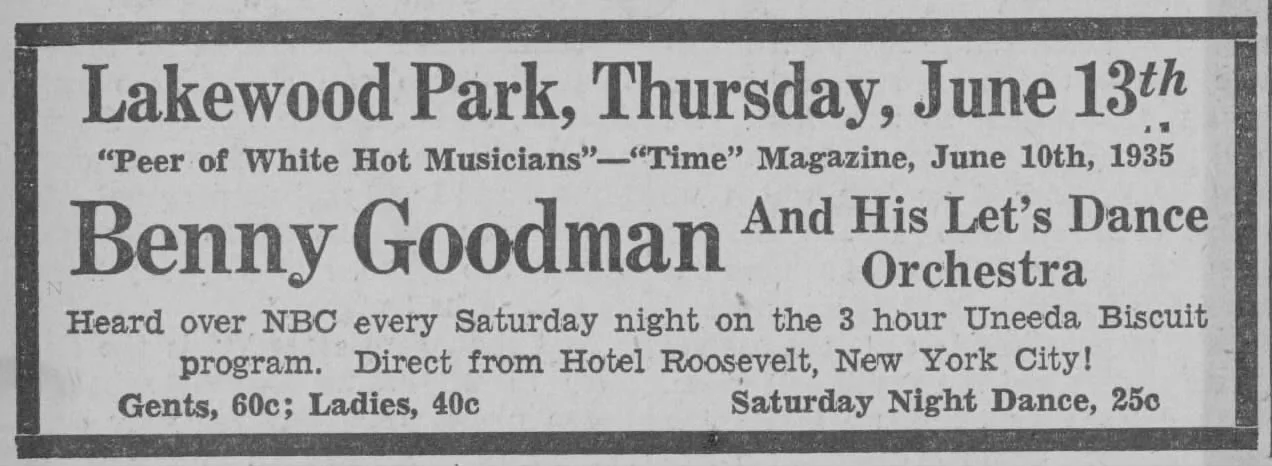
The Record American, Mahanoy City, PA, Wednesday, June 12, 1935.
The Benny Goodman Orchestra
July 16, 1935-May 23, 1936, Tour (4) (1)
Benny Goodman-Clarinet, Bunny Berigan, Nate Kazebier, Ralph Muzzillo-Trumpets, Red Ballard, Jack Lacey-Trombones, Hymie Schertzer, Bill DePew-Alto Sax, Art Rollini, Dick Clark-Tenor Sax, Jess Stacey-Piano, Allan Reuss-Guitar, Harry Goodman-Bass, Gene Krupa-Drums, Helen Ward, Joe Harris-Vocals, Mort Davis-Road Manager.
NOTE: Harry Geller is reported to have been in the band on opening night @ The Palomar; it is unknown who he replaced in the trumpet section. Joe Harris replaced Jack Lacey in the trombone section ca. September 27. (4) (1)
GEORGE T. SIMON: But (Willard) Alexander kept plugging. He drew strong support from John Hammond, the most enthusiastic and influential jazz buff around, who had encouraged Benny to organize a band in the first place. After the Roosevelt fiasco, Willard booked Goodman on some one-nighters, and these, plus some record dates, kept the band working. (20)
BENNY GOODMAN: By this time, I had decided to take a chance on the trip to the (west) coast, and Willard (Alexander) got us some bookings along the way that would keep us busy until we hit the Palomar. The decision to take the trip meant more changes in the band, because a couple of the boys preferred to stay in New York and do other jobs. One of them was George Van Eps, our guitar player. He had a fellow studying with him who played his style, and he suggested we try him out. That was Allan Reuss, who joined the band for the trip and stayed with us for three years. (18)
ARTHUR ROLLINI: In July we began our first national tour. I bought a new 1935 Ford Coupe, and Allan Reuss, who replaced George Van Eps on guitar, was my co-driver. (5)
GEORGE T. SIMON: Benny and his clarinet became a symbol of emotional and musical communication between those on the stand and those who gathered around to watch, to worship, to dance and to listen, in person, on records and over the radio. (20)
MICHIGAN, OHIO, WISCONSIN, COLORADO
1935, Tue, July 16: Ocean Beach Pier, Clark Lake, MI. (Bunny Berigan & Jess Stacey join the Goodman band)
1935, Wed, July 17: Toledo, OH. (Venue unk.)
1935, Thu July 18: Russell’s Point, Lima, OH.
1935, Fri, July 19: Luna Pier, Lakeside, MI.
1935, Sat, July 20: Mile a‑Way Ballroom, Grand Rapids, MI.
1935, Sun, July 21: Modernistic Ballroom, Milwaukee, WI.
1935, Mon, July 22: Modernistic Ballroom, Milwaukee, WI.
1935, Tue, July 23-Thu 25: Travel days from Milwaukee, WI to Denver, CO.
ARTHUR ROLLINI: We did many one-nighters on the way to Denver, Colorado, where we were to open at Elich’s Garden, a dime-a-dance place. We were booked there for three weeks. However, it was plain to see that we were a flop. Our NBC program had not reached Denver and, although the band sounded great, we were not being accepted. The manager wanted us to play waltz sets in between the regular sets, and Benny was disheartened. (5)
1935, Fri, July 26-Thu, August 15: Benny Goodman Orchestra @ Elitch’s Garden, Trocadero Ballroom, Denver, CO for three weeks. (4).
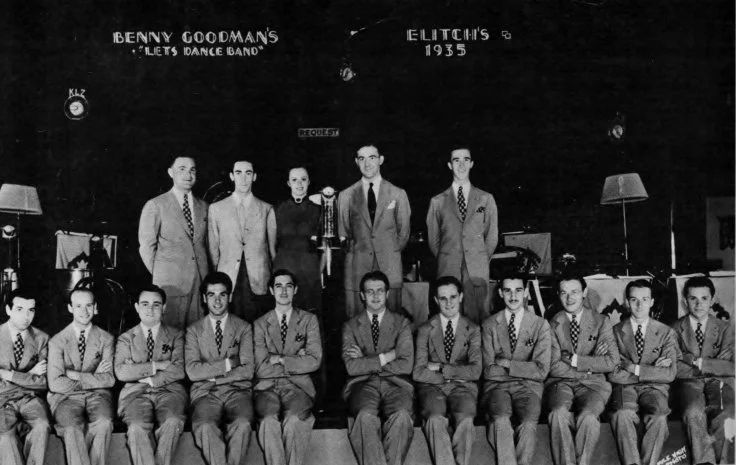
Elitch’s Garden, Trocadero Ballroom, Denver, CO, July-August 1935. Allan Reuss, seated far right.
GEORGE T. SIMON: On opening night, people started asking for their money back, and the manager wouldn’t be mollified until the band started playing waltzes. (20)
COLORADO, UTAH, CALIFORNIA
1935, Fri, Aug 16: Mile a-Way, Grand Junction, CO.
1935, Sat, Aug 17: Cocoanut Grove Ballroom, Salt Lake City, UT.
1935, Sun, Aug 18: Travel Day.
1935, Mon, Aug 19: McFadden’s Ballroom, Oakland, CA.
1935, Tue, Aug 20: Pismo Pavilion, Pismo Beach, CA.
Los Angeles, California
THE PALOMAR
August 21-October 01, 1935
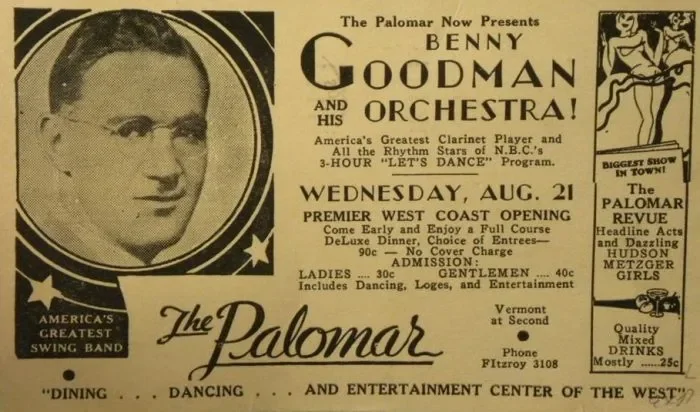
1935, Wed Aug 21-Tue Oct 01: Benny Goodman Orchestra, The Palomar, Los Angeles, CA, for six weeks. (4)
Monday-Saturday, Dinner/Dance: 8 pm-1 am.
Monday-Saturday, Broadcasting 11 pm- 11:30 p.m., Tuesdays (some), 8 pm-8:30 pm across the Don Lee-Columbia Network: KFRC/KHJ (Los Angeles), KMJ (Fresno), KWG (Stockton), KFBK (Sacramento). NOTE: The Don Lee-Columbia Network was CBS’s western outlets. (25)
Sunday: Day Off.
Only one aircheck was captured during this six-week run (Thursday, August 22, 1935, KHJ, Los Angeles, CA).
GENE KRUPA: (On the first night) we played the first couple of sets under wraps. We weren't getting much reaction, so Benny, I guess, decided to hell with playing it safe, and we started playing numbers like KING PORTER STOMP. Well, from then on, we were in! (20)
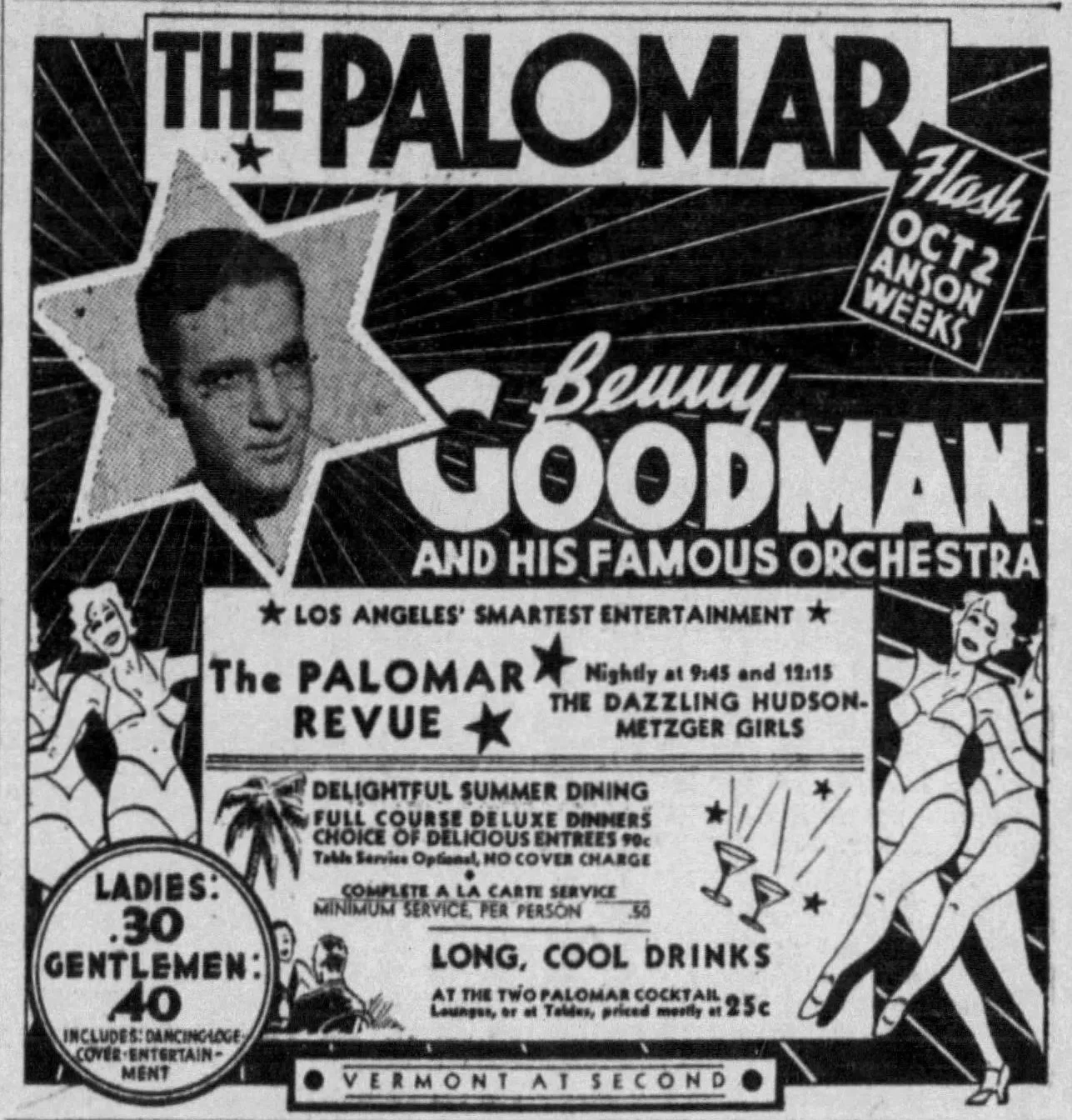
The Los Angeles Times, Los Angeles, CA, Friday, September 13, 1935.
ARTHUR ROLLINI: While at the Palomar Ballroom, Allan and I decided to visit Tijuana, Mexico on a day off. We were admitted ok at the border, but on our return we were detained by the authorities when they opened the trunk and saw the PA (an auxiliary public address system Goodman carried along in case a venue did not have a PA system, which was never the case). (5)
ARTHUR ROLLINI: We found a Spanish-style apartment on Berendo Street, a beautiful residential section lined with palm trees. It was near the Palomar Ballroom, where we were to play. Allan took an apartment for $14 per week, and I chose one for $18. (5)
CALIFORNIA, TEXAS
1935, Thu, Oct 10: Long Beach Municipal Auditorium, Long Beach, CA.
1935, Fri, Oct 11: Long Beach Municipal Auditorium, Long Beach, CA.
1935, Sat, Oct 12: Riverside Auditorium, Riverside, CA.
1935, Thu, Oct 17-Wed, Oct 23: Paramount Theatre, Los Angeles, CA.
1935, Fri, Oct 25: University of Texas El Paso Lobby Dance @ Hotel Paso del Norte, El Paso, TX.
1935, Mon, Oct 28: Concert @ Municipal Auditorium, Amarillo, TX.
1935, Mon, Oct 28: Dance @ The Nat Dance Palace, Amarillo, TX.
1935, Thu, Oct 31: Ridotto Club Annual Fall Formal, Fort Worth Club, Fort Worth, TX.
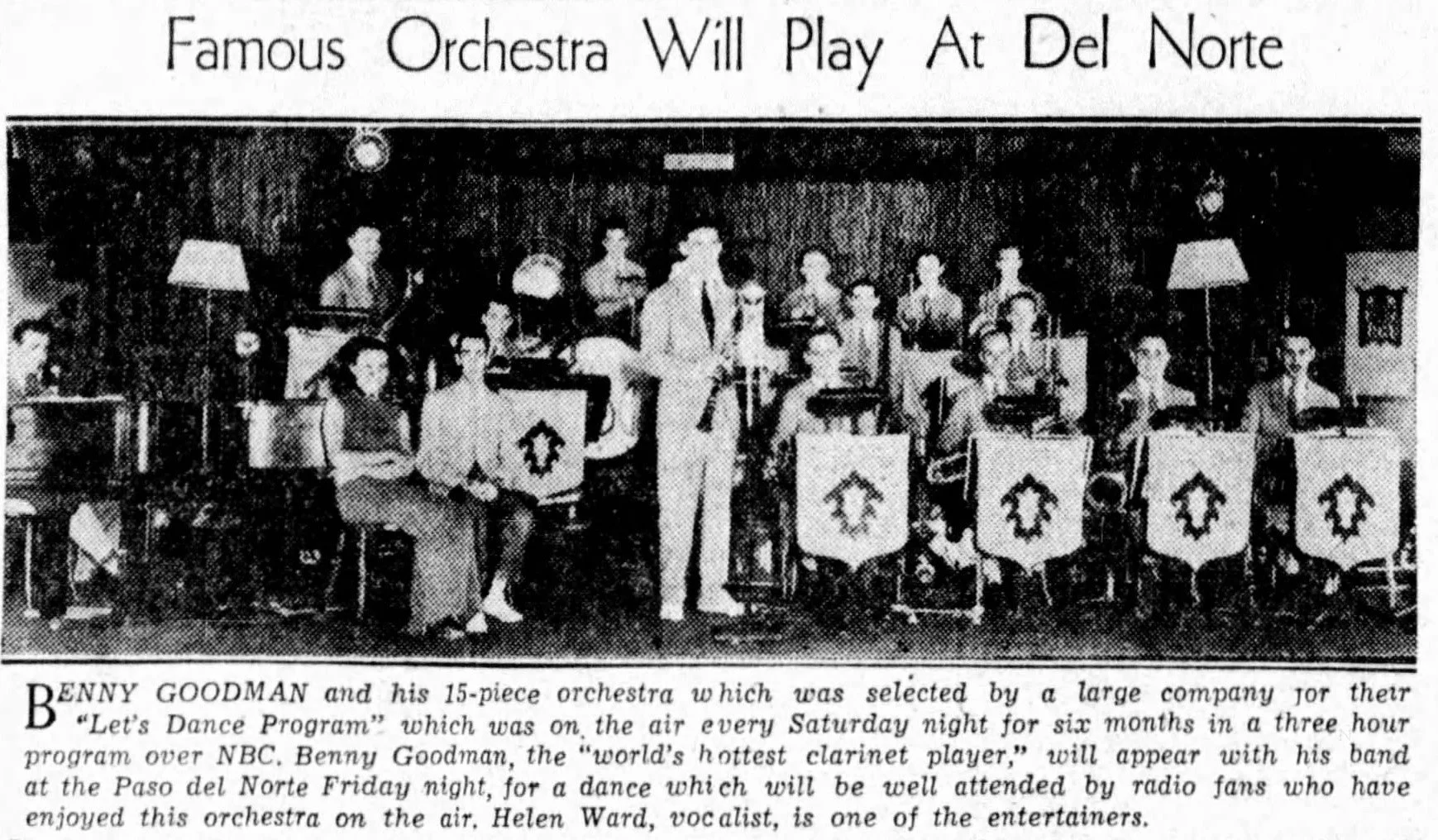
El Paso Times, El Paso, Texas, Monday, October 21, 1935.
NOTE: Photo is pre-September 27, as Joe Harris is seated for vocals and Jack Jacey is still in the trombone section.
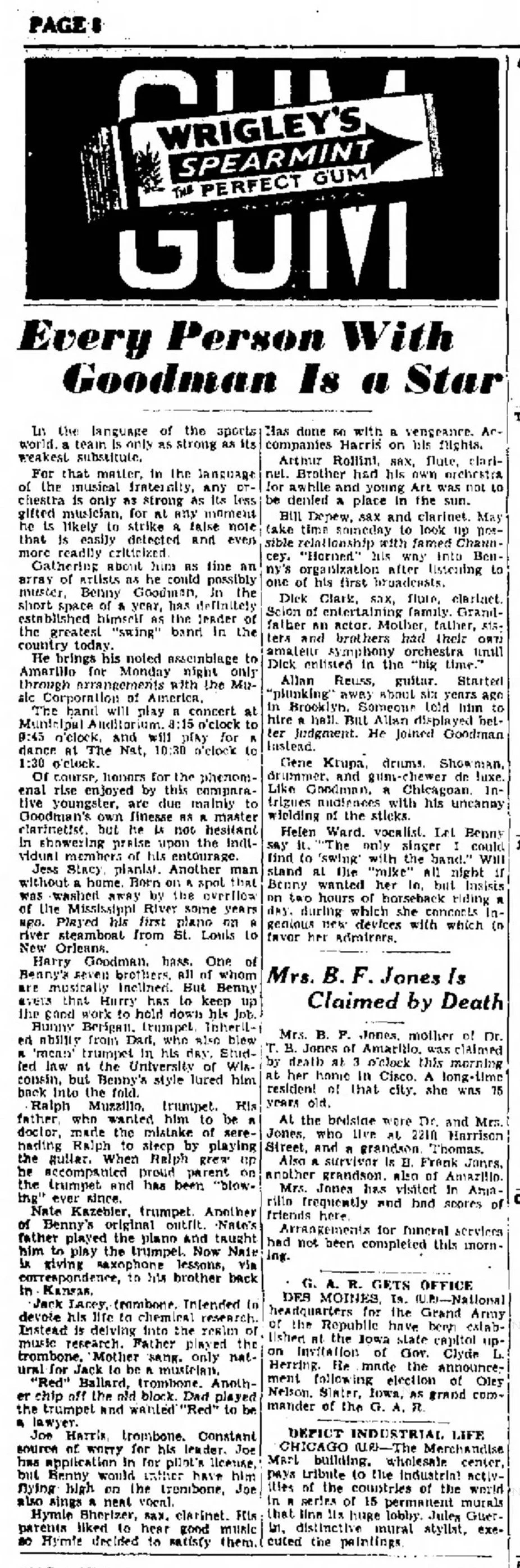
Every Person With Goodman Is a Star.
The Amarillo Globe-Times, Amarillo, Texas, Thursday, October 24, 1935.
Allan Reuss guitar. Started “plunking” away about six years ago in Brooklyn. Someone told him to hire a hall. But Allan displayed better judgment. He joined Goodman instead.
CHICAGO
CONGRESS HOTEL
Joseph Urban Room
Chicago, Illinois
November 06, 1935-May 23, 1936
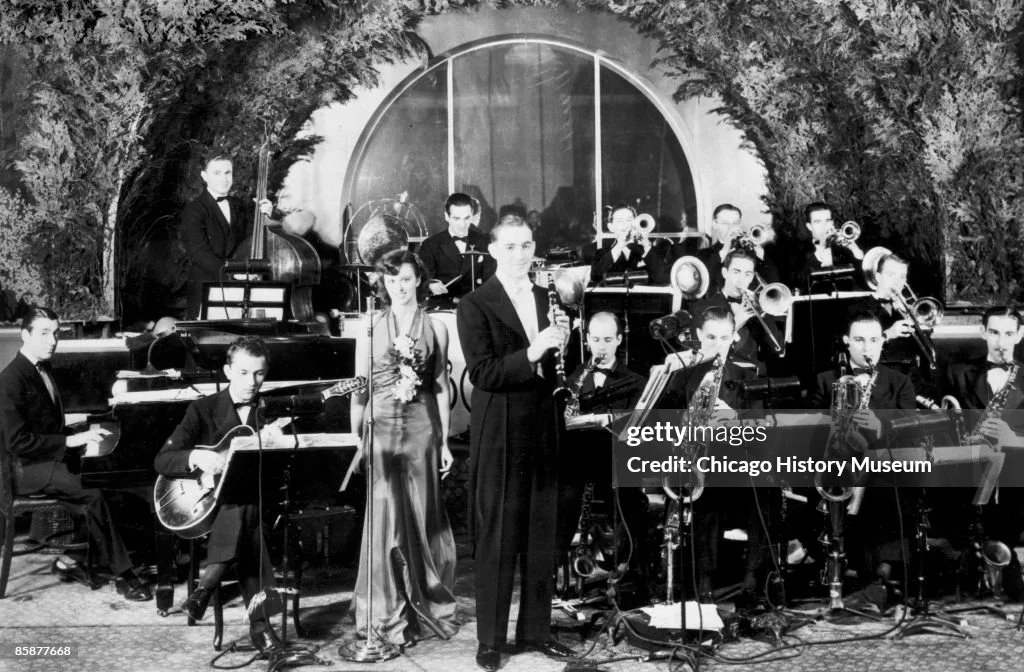
Benny Goodman Orchestra @ Congress Hotel, Joseph Urban Room, Chicago, IL.
1935, Mon/Tue, Nov 18 or 19: Gene Krupa and His Chicagoans, Decca recording session, Chicago, IL. (6)
1935, Fri, Nov 22: Benny Goodman Orchestra, Victor recording session-SOLO: If I Could Be With You (One Hour Tonight), Chicago, IL. (4)
George Van Eps w/Ted Greene-1981 Interview excerpt
1935, Mon, Nov 25: Arthur Rollini marries Ena Kelsall, Allan Reuss is the best man, Chicago, IL. (5)
1936
A daily schedule that included hotel gigs, broadcasts, tours, and recording sessions with Benny Goodman, Gene Krupa, Teddy Wilson, Putney Dandridge
1936, Thu, Jan 02: Benny Goodman Orchestra, Victor recording session, Chicago, IL. (4)
1936, Sat, Feb 29: Gene Krupa’s Swing Band, Victor recording session, Chicago, IL. (4)
1936, Fri, Mar 20: Benny Goodman Orchestra, Victor recording session, Chicago, IL. (4)
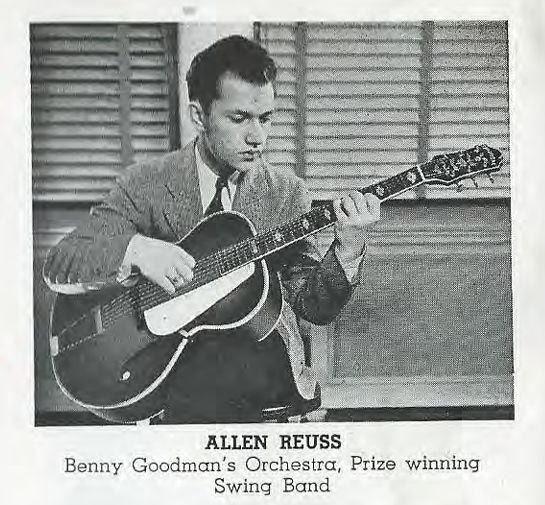
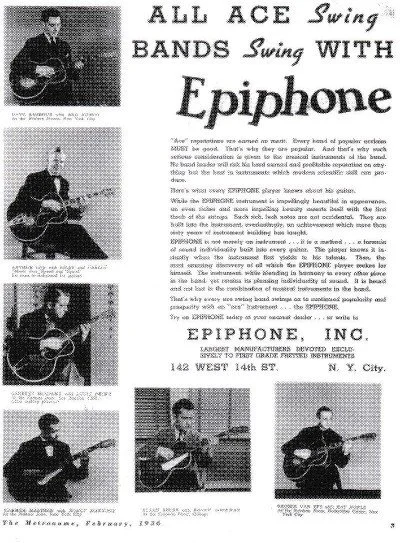
Epiphone Ad, Metronome, April 1936.
1936, Thu, Apr 23: Benny Goodman Orchestra, Victor recording session, Chicago, IL. (4)
1936, Wed, May 27: Benny Goodman Orchestra, Victor recording session, NYC. (4)
1936, Mon, Jun 15: Benny Goodman Orchestra, Victor recording session, NYC. (4)
1936, Tue, Jun 16: Benny Goodman Orchestra, Victor recording session, NYC. (4)
1936, Tue, Jun 30-1938, Jun: Benny Goodman Orchestra, Camel Caravan NBC/CBS Radio Broadcasts. (15)
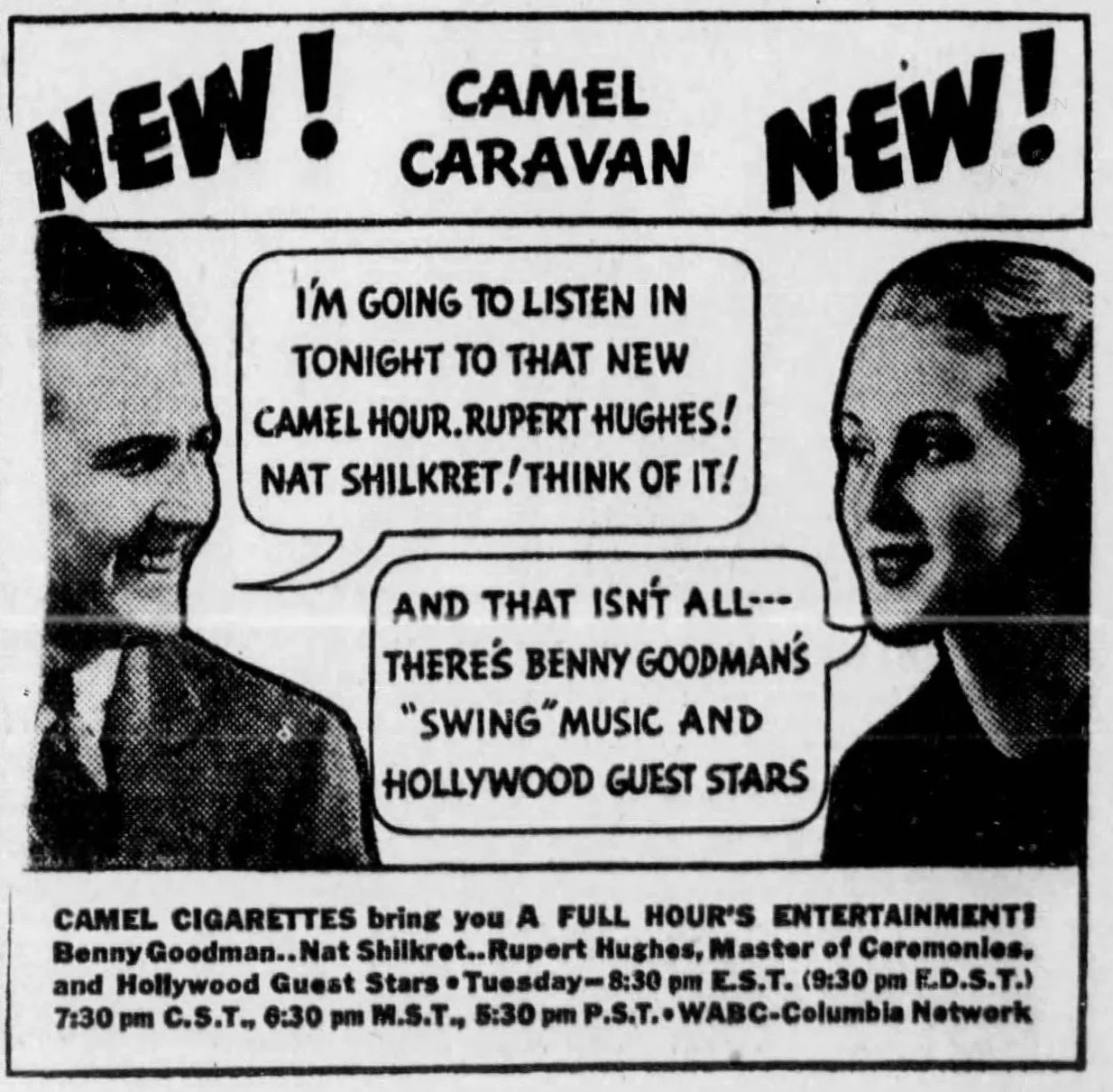
The Minneapolis Star, Minneapolis, MN, Tuesday, June 30, 1936.
JULY 01-AUGUST 25, 1936
Return to The Palomar
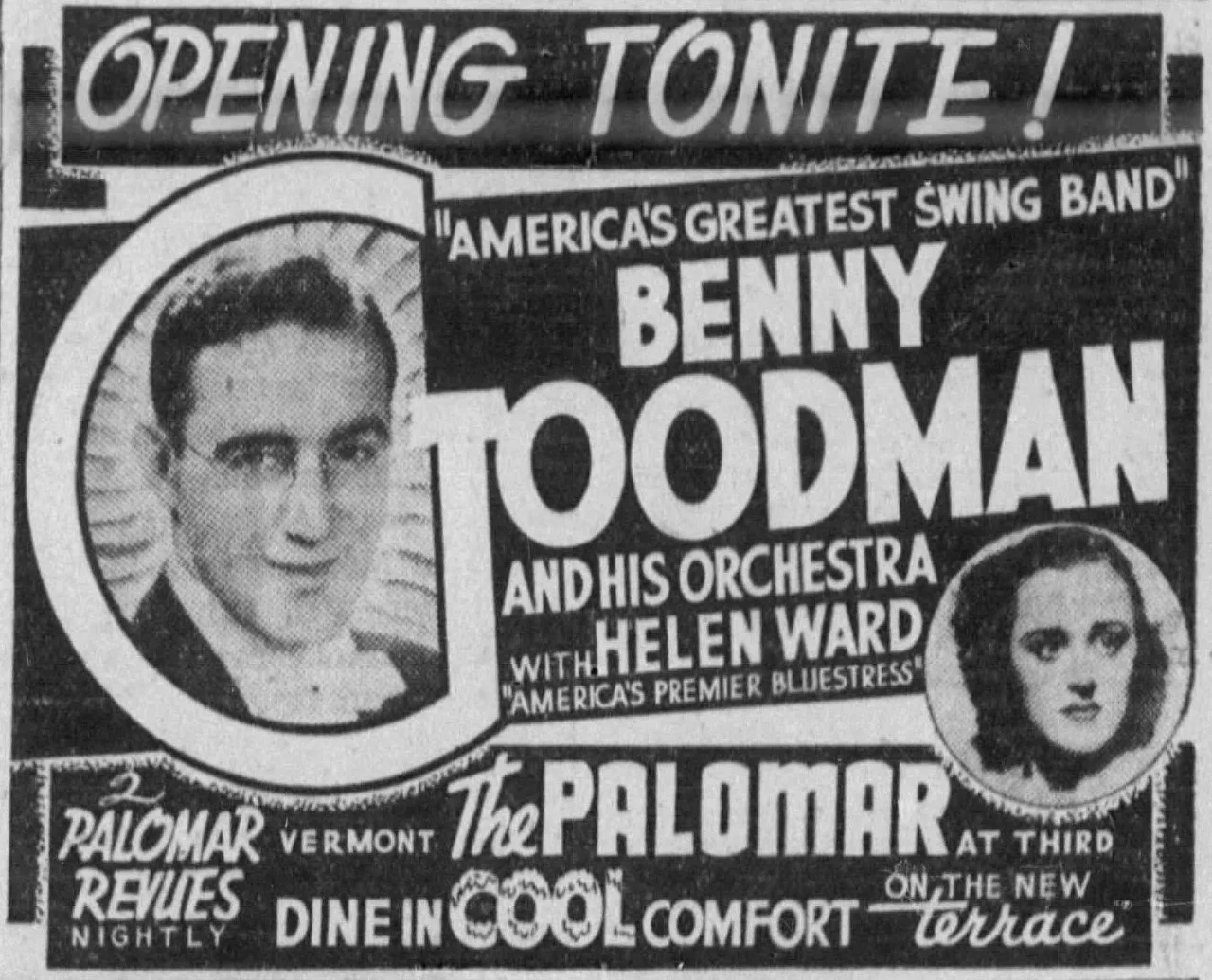
The Los Angeles Times, Los Angeles, CA, Wednesday, July 1, 1936.
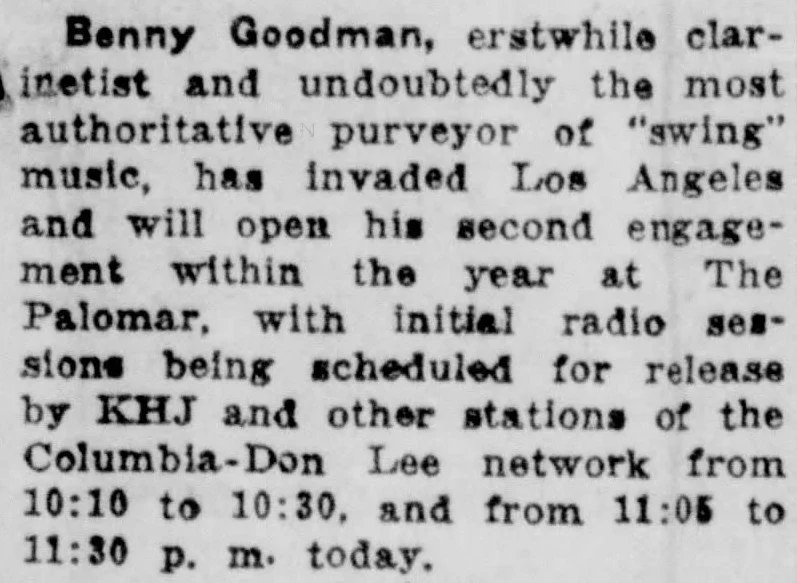
The Register, Santa Ana, CA, Wednesday, July 01, 1936.
1936, Wed, Jul 01-Tue, Aug 25: Benny Goodman Orchestra, The Palomar, Los Angeles, CA.
Monday-Saturday, Dinner/Dance: 8 pm-1 am.
Monday-Saturday, Broadcasting 11 pm-11:30 pm across the Don Lee-Columbia Network: KFRC/KHJ (Los Angeles), KMJ (Fresno), KWG (Stockton), KFBK (Sacramento). NOTE: The Don Lee-Columbia Network was CBS’s western outlets. (25)
Tuesday: The New Camel Hour (Camel Caravan), CBS Network Broadcast w/guests, 8 pm-8:30 pm.
Sunday: The Palomar Day Off.
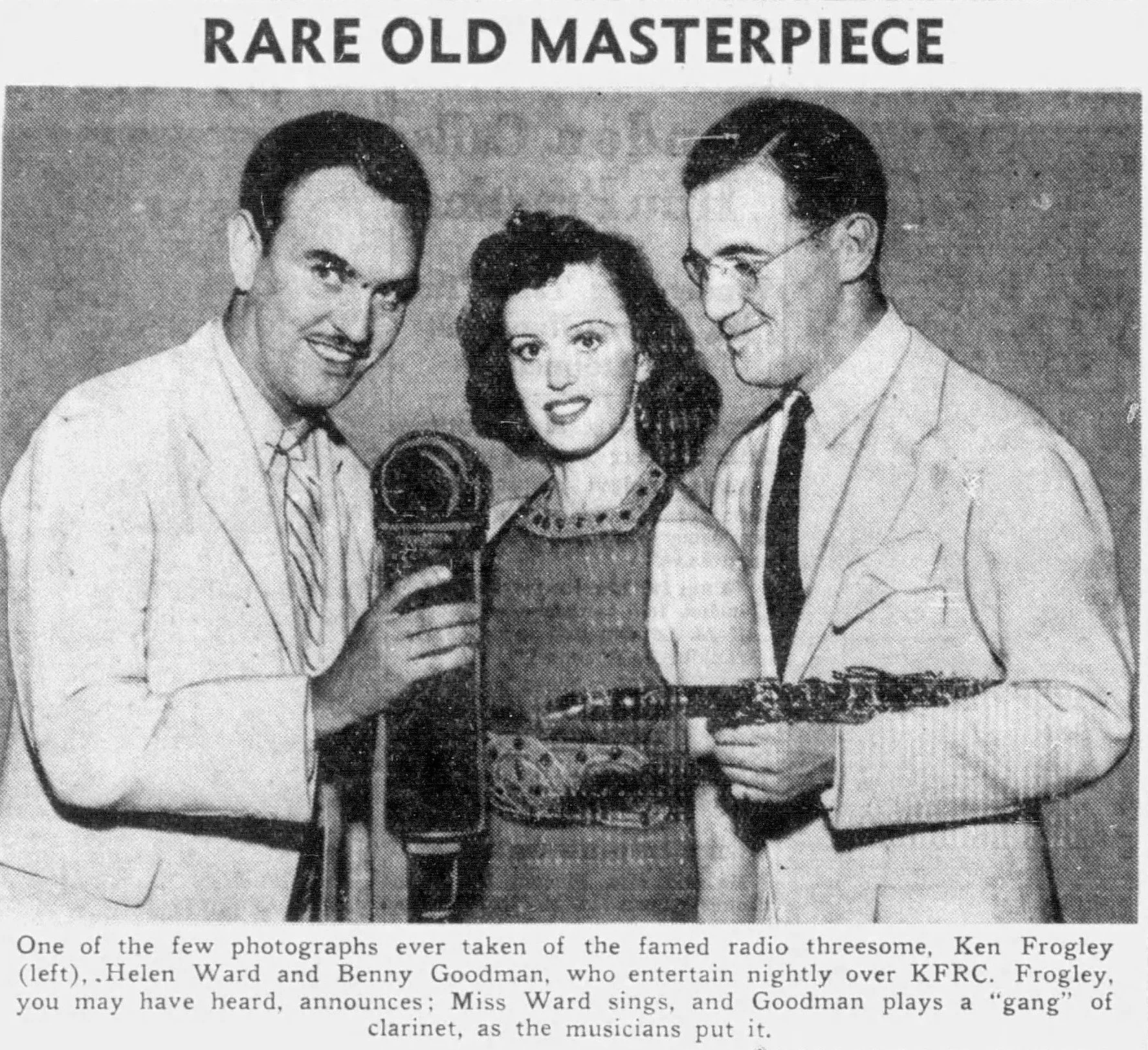
San Francisco Chronicle, San Francisco, CA, Wednesday, July 29, 1936.
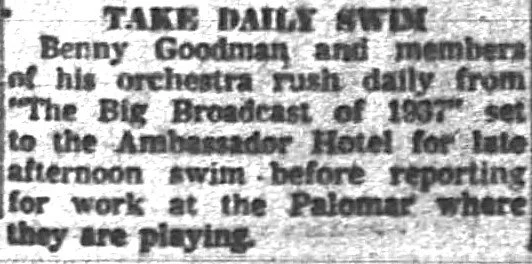
Deseret News, Salt Lake City, UT, Friday, August 14, 1936.
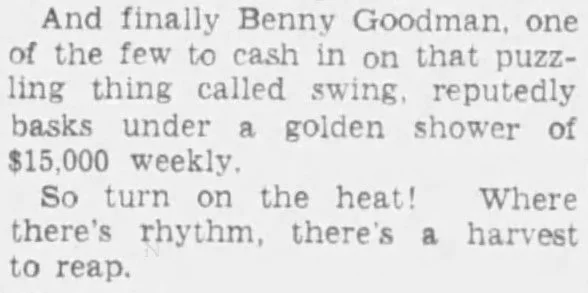
San Francisco Chronicle, San Francisco, CA, Sunday, July 26, 1936.
JULY-AUGUST 1936
Hollywood, California
Paramount Pictures
Filming
THE BIG BROADCAST OF 1937
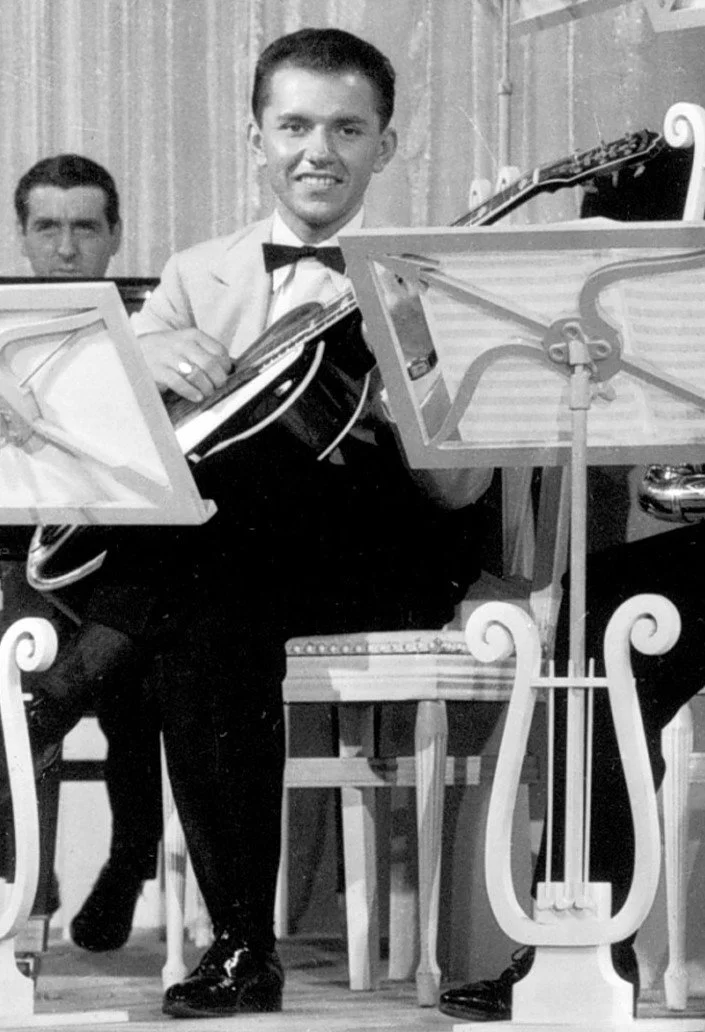
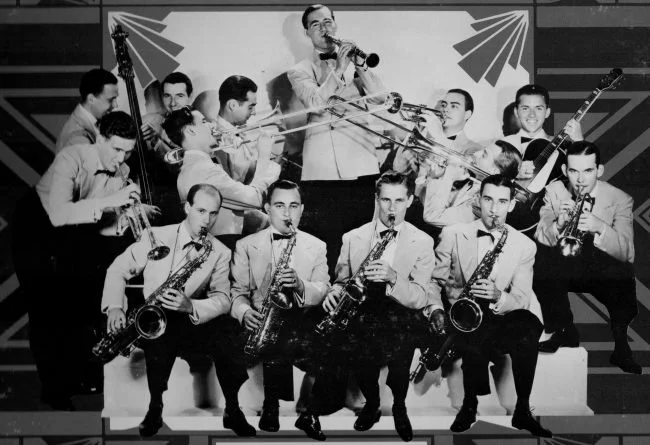
1936, July-August: Benny Goodman Orchestra-The Big Broadcast of 1937, Paramount Pictures (released October 06, 1936, TBD), Hollywood, CA. (4)
1936, Thu, Aug 13: Benny Goodman Orchestra, Victor recording session, Hollywood, CA. (4)
1936, Sun, Aug 16: Benny Goodman Orchestra, Mandarin Ballroom, Redondo Beach, South Bay, Greater Los Angeles, CA.
1936, Fri, Aug 21: Benny Goodman Orchestra, Victor recording session, Hollywood, CA.
Allan Reuss solo featured on two takes of LOVE ME, OR LEAVE ME. (4)
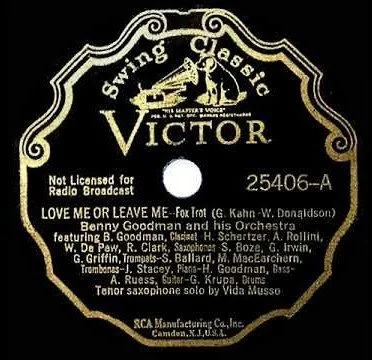
1936, Sun, Aug 23: Benny Goodman Orchestra, Mission Beach Ballroom, San Diego, CA.
1936, Mon, Aug 24: Teddy Wilson, Brunswick recording session, Hollywood, CA. (2)
1936, Tue, Oct 06 TBD: The Big Broadcast of 1937, Paramount Pictures released. (26)
1936, Wed, Oct 07: Benny Goodman Orchestra, Victor recording session, NYC. (4)
1936, Wed, Oct 21: Teddy Wilson/Billie Holiday, Brunswick recording session, NYC. (2)
1936, Wed, Oct 28: Teddy Wilson/Billie Holiday, Brunswick recording session, NYC. (2)
1936, Thu, Nov 05: Benny Goodman Orchestra, Victor, recording session, NYC. (4)
1936, Thu, Nov 19: Teddy Wilson/Billie Holiday, Brunswick recording session, NYC. (2)
JOHN HAMMOND: By the winter of 1936-37, Benny Goodman had become so popular that he was offered his own radio network show sponsored by Camel cigarettes. The William Esty advertising agency had the Camel account, and its target was the college market, the most enthusiastic Goodman fans. (17)
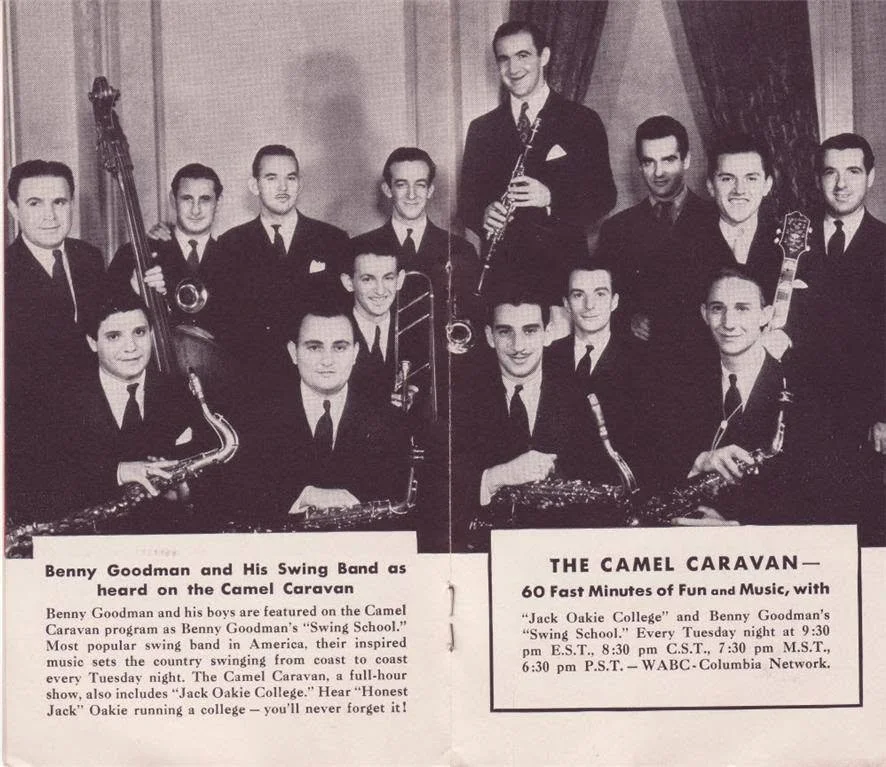
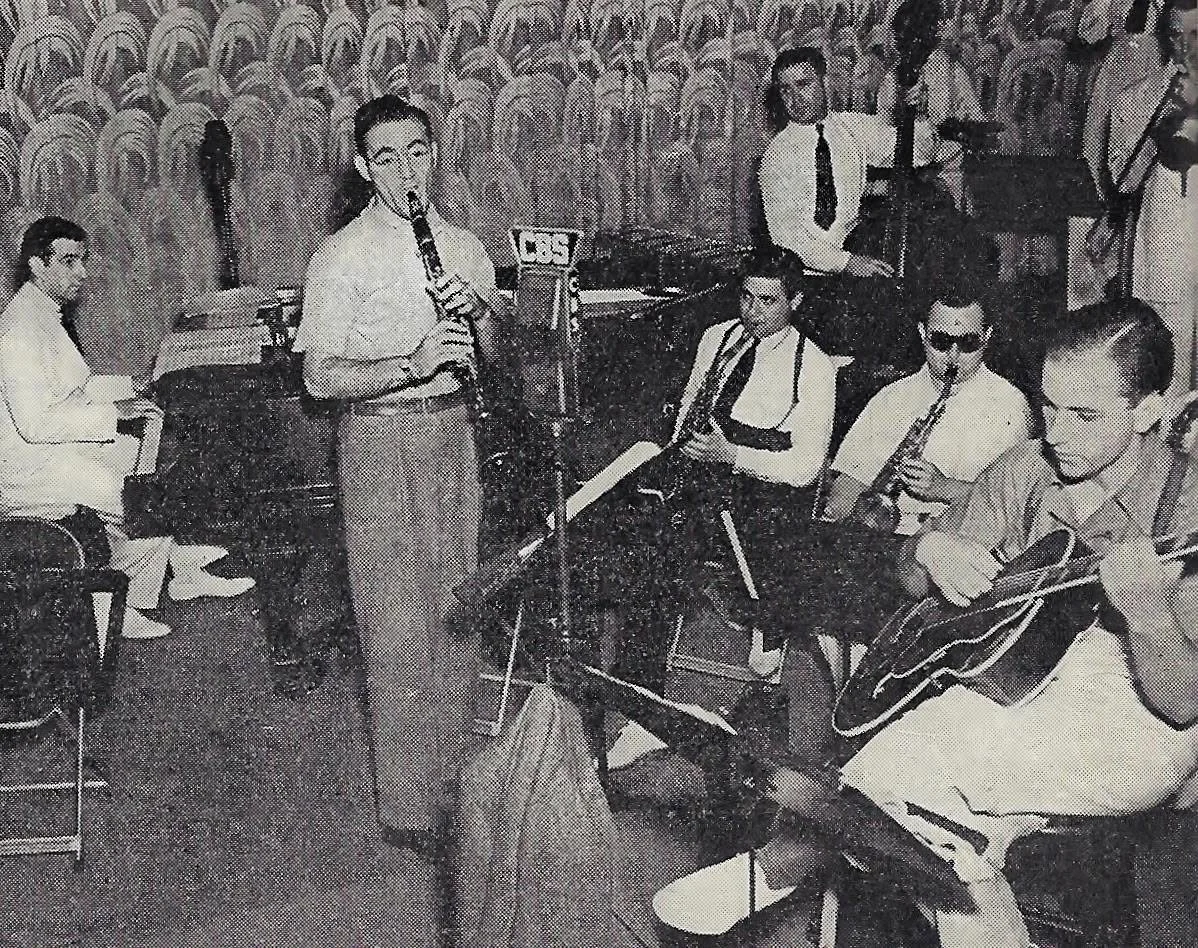
Benny Goodman Orchestra, The New Camel Hour (The Camel Caravan), CBS broadcast rehearsal, ca. December 1936.
1936, Wed, Dec 09: Benny Goodman Orchestra, Victor recording session, NYC. (4)
1936, Thu, Dec 10: Putney Dandridge, Vocalion recording session, NYC. (6)
1936, Wed, Dec 16: Teddy Wilson, Brunswick recording session, NYC. (2)
1936, Wed, Dec 30: Benny Goodman Orchestra, Victor recording session, NYC. (4)
SOURCES
1. Mr. Trumpet. The Trials, Tribulations, and Triumph of Bunny Berigan, Michael P. Zirpolo, Studies in Jazz, No. 64, The Scarecrow Press, 2011.
2. Classic Brunswick & Columbia Teddy Wilson Sessions 1934-1942, Mosaic Records MD7-265, 2017.
3. The Complete Lionel Hampton Victor Sessions 1937-1941. Mosaic Records MD5-238, 2007.
4. BG On The Record, A Bio-Discography of Benny Goodman, D. Russell Connor & Warren W. Hicks, Arlington House, 1973.
5. Thirty Years With The Big Bands, Arthur Rollini, Bayou Press, 1987.
6. Jazz Records 1897-1942, Brian Rust, Arlington House, 1978.
7. The Complete Columbia Recordings of Mildred Bailey, Mosaic Records MD10-204, 2000.
8. The New Edition of the Encyclopedia of Jazz, Leonard Feather, Bonanza Books, NY, 1960 (as submitted by Allan Reuss).
9. HMR Project: www.violafair.com/hmrproject/r/reuss-allan.htm.
10. Down Beat Magazine, December 1944, Vol. 11, Issue 2. Wins poll w/83 votes, Oscar Moore second place w/45 votes.
11. Who’s Who of Jazz, John Chilton, Da Capo, 1985.
12. The Great Guitarists: The Ultimate Guide, Scott Yanow, Backbeat Books, 2013.
13. ancestors.familysearch.org.
14. Brooklyn Eagle, Brooklyn, New York, Wednesday, January 21 & 28, 1925.
15. vintageradioshows.com/shows/benny-goodmans-camel-caravan.
16. lassebohlinmagnuskarlsson.com.
17. John Hammond On Record, John Hammond, The Ridge Press, 1977.
18. The Kingdom Of Swing, Benny Goodman & Irving Kolodin, Frederick Ungar Publishing Co., 1939.
19. Simon Says, The Sights and Sounds of the Swing Era, 1935-1955, George T. Simon, Galahad Books, 1971.
20. The Big Bands, George T. Simon, Collier Books, 1974.
21. Don Lee Network, en.wikipedia.org/wiki/Don_Lee_Network.
22. Local Voices: The Don Lee and Yankee Networks, Elizabeth McLeod.
23. Lost Chords: White Musicians and Their Contribution to Jazz, 1915-1945, Richard M. Sudhalter, Oxford University Press, 1999.
24. Epiphone, The House Of Stathopoulo, Jim Fisch & L.B. Fred, Amsco, 1996.
25. American Radio Networks, Jim Cox, McFarland & Company, 2009.
26. en.wikipedia.org/wiki/The_Big_Broadcast_of_1937